
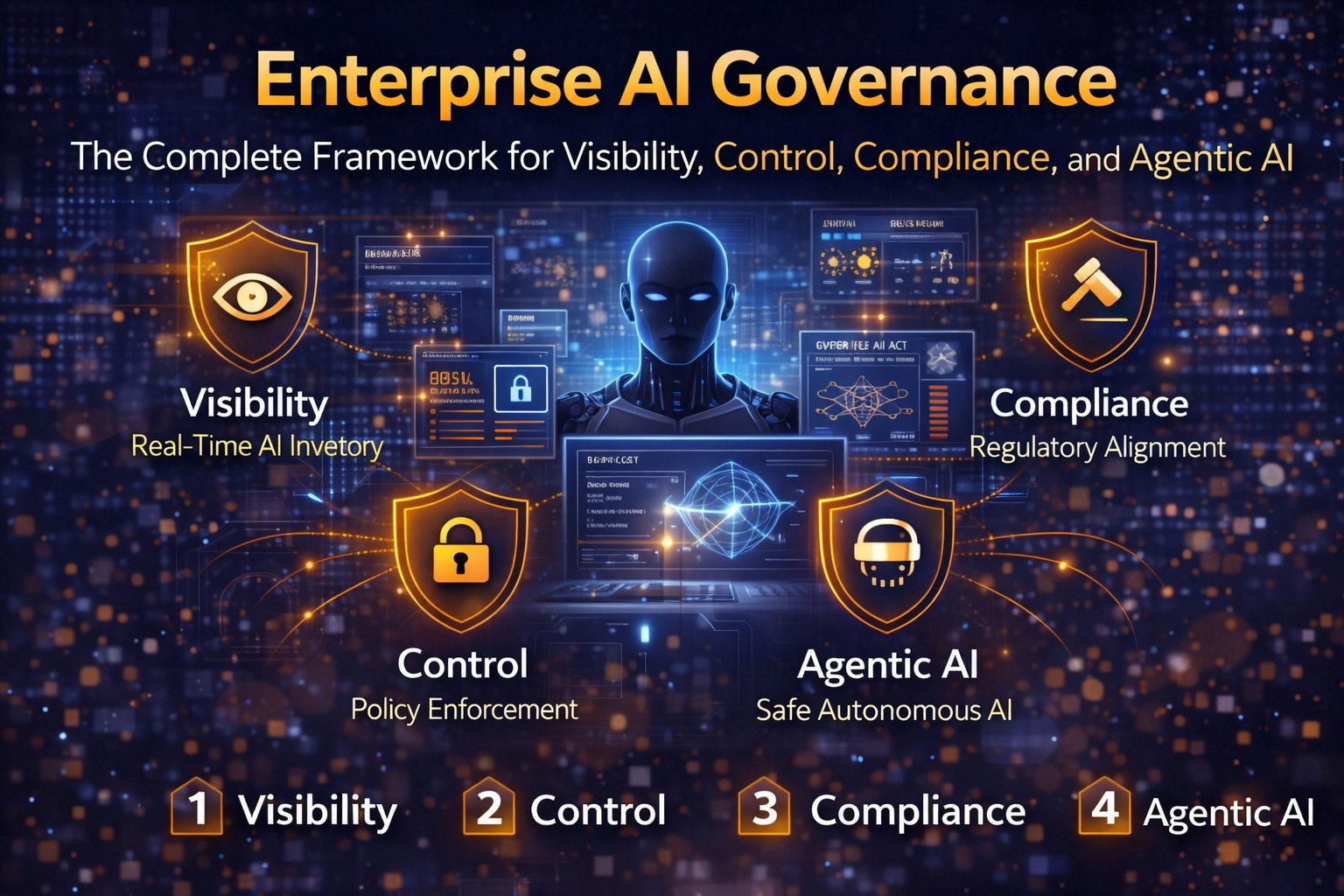
What Enterprise AI Governance Actually Means Beyond the Policy Document
Enterprise AI governance is frequently misunderstood as a documentation exercise: write a policy, update the acceptable use standards, and the governance obligation is met. This framing is wrong in a way that has already caused measurable harm to organizations that have adopted it. Real enterprise AI governance is a living control system a set of operational mechanisms that provide continuous visibility into how AI is being used, enforce policies in real time rather than after the fact, create auditable records of every significant AI decision, and adapt dynamically as AI systems evolve and the regulatory environment changes. It is as much a technology challenge as a policy challenge, because AI systems operate at a speed and scale that human oversight alone cannot match. The distinction matters practically. A policy document that prohibits employees from uploading PII to consumer AI tools cannot detect that the prohibition is being violated 48% of the time (per the January 2026 survey data on Shadow AI). A governance framework with technical controls AI discovery tooling, DLP extended to AI endpoints, runtime prompt inspection can detect and prevent that violation in real time. Deloitte’s 2026 State of AI in the Enterprise survey, drawing on 3,235 senior leaders across 24 countries, found that only 1 in 5 companies has a mature model for governance of autonomous AI agents and that agentic AI usage is poised to rise sharply in the next two years. This is the central challenge of 2026: governance programs built for static AI tools are being outpaced by agentic AI systems that act, decide, and access data autonomously. The governance framework must be built for the AI that is coming, not the AI that was already here.The State of Enterprise AI Governance in 2026: 16 Critical Statistics
Before building your governance framework, understand the environment it must operate in. These data points define the problem with precision:| Finding | Statistic | Source |
| Organizations with fully implemented AI governance programs | 25% | AuditBoard, 2025 |
| Boards with AI governance formally in committee charters | 27% | Industry research, 2025 |
| Organizations actively working on AI governance | 77% | IAPP, 2025 |
| Enterprises planning to increase AI governance budgets | 98% | OneTrust, Sept 2025 |
| Average AI governance budget increase anticipated | 24% | OneTrust, Sept 2025 |
| IT leaders with advanced AI adoption who found governance gaps | 86% | OneTrust, Sept 2025 |
| Breached organizations with no formal AI governance policy | 63% | IBM CODB 2025 |
| AI breach victims who lacked proper AI access controls | 97% | IBM CODB 2025 |
| Shadow AI tools operating without IT approval | 65% | Vectra AI / IBM, 2025 |
| Additional breach cost attributable to Shadow AI | $670,000 per incident | IBM CODB 2025 |
| CxOs who believe their AI risk approach is insufficient | 50% | EY, 2025 |
| Organizations with mature governance for autonomous AI agents | 20% (1 in 5) | Deloitte, 2026 |
| Enterprise AI governance market size in 2025 | $227–340 million | Vectra AI, 2025 |
| Projected AI governance market by 2034 | $4.83 billion (35–45% CAGR) | Vectra AI, 2025 |
| IT leaders who spent more time managing AI risks in 2025 | 37% more time vs. 2024 | OneTrust, Sept 2025 |
| C-suite leaders with C-suite AI governance leadership 3x more likely to have mature programs | 3x more likely | Vectra AI, 2025 |
⚠️ The Execution Gap: 77% of organizations are working on AI governance. Only 25% have fully implemented it. The gap between those numbers representing hundreds of billions of dollars in unmitigated AI risk across the global enterprise landscape is the governance execution problem. It is not a lack of awareness. It is a failure to translate policy into operational controls.
Why Traditional IT Governance Fails for AI: The 5 Fundamental Differences
The most common governance failure mode is applying frameworks built for traditional IT systems deterministic, auditable, rule-based software to AI systems that operate on fundamentally different principles. Understanding exactly where and why traditional governance fails for AI is the prerequisite for building something that actually works.1. AI Systems Are Non-Deterministic
Traditional software produces predictable, reproducible outputs from identical inputs. An AI model does not. The same prompt, submitted twice to the same LLM, can produce different outputs. This means governance cannot rely on testing outputs in a pre-deployment validation environment and assuming they represent production behavior. Governance must operate at runtime, continuously, because AI behavior at any moment may differ from AI behavior at any prior moment.2. Inputs Carry Risk, Not Just Outputs
Traditional IT governance focuses on controlling what systems produce. For AI systems, the inputs the prompts, the documents, the data provided by users carry as much or more risk than the outputs. A user who pastes a confidential financial projection into a prompt has created a data governance event whether or not the AI produces a problematic response. OWASP identifies sensitive information disclosure as a top LLM risk precisely because the disclosure can occur through the input path, not just the output path. Governance that monitors outputs but not inputs is missing half the risk surface.3. The Blast Radius of a Single AI Access Point Is Much Larger
In traditional software, a compromised user account typically exposes the data that account has access to. An AI agent with broad permissions typical for agents designed to be genuinely useful across multiple systems can, if compromised or manipulated, access data across every system it is authorized to interact with, synthesize that data into new forms, and transmit it through seemingly legitimate channels. Traditional access control audits that evaluate permissions in isolation do not capture the compound risk of AI agent access.4. The Threat Landscape Is AI-Specific
Prompt injection, model poisoning, training data exfiltration, and jailbreaking are attack categories with no direct analogues in traditional software security. These threats require governance controls specifically designed for AI systems controls that traditional IT governance frameworks do not include. An organization that has excellent traditional IT security and zero AI-specific controls is not governing its AI.5. Regulatory Accountability Sits with the Organization, Not the AI Vendor
Gartner and EU regulators are both explicit on this point: organizations are responsible for the AI outcomes they deploy, regardless of whether the underlying model was built by a third-party vendor. This means that deploying ChatGPT Enterprise, Copilot, or any other externally developed AI tool does not transfer governance responsibility to Microsoft, OpenAI, or any other provider. The enterprise that deploys the tool is accountable for how it is used, what data flows through it, what decisions it informs, and whether those decisions comply with applicable regulations.The Six Pillars of Enterprise AI Governance
A complete enterprise AI governance framework operates across six interdependent pillars. Each addresses a distinct governance failure mode. Organizations that implement some pillars but not others will find that their governance gaps concentrate in exactly the areas they have neglected.| Pillar | What It Governs | Core Capabilities Required | Governance Failure Without It |
| 1. Visibility & Discovery | What AI tools and systems are in use, by whom, across all business units | Continuous AI app discovery, Shadow AI detection, AI inventory management, usage monitoring | 86% of organizations are blind to AI data flows. You cannot govern what you cannot see. |
| 2. Identity & Access Control | Who can use which AI tools, with which data, under what conditions | Role-based AI access, conditional policies, least privilege, non-human identity governance | 97% of AI breach victims had no proper access controls. Access governance is the #1 enforcement gap. |
| 3. Data Protection & DLP | What data flows into and out of AI systems, and whether that flow is authorized | Prompt inspection, output scanning, DLP for AI endpoints, data classification, CASB | 65% of AI tools operate without IT approval. Data leakage through AI is invisible without runtime controls. |
| 4. Risk Assessment & Management | The risk profile of each AI system and the controls applied proportional to that risk | AI risk register, risk tiering, conformity assessment, third-party AI vendor risk | 50% of CxOs believe their AI risk approach is insufficient. Risk without assessment is unmanaged. |
| 5. Compliance & Audit Readiness | Whether AI usage meets regulatory obligations and can be demonstrated to regulators | Immutable audit logs, policy documentation, regulatory mapping, evidence management | 63% of breached organizations had no governance policy. Compliance requires operational evidence, not aspirations. |
| 6. Agentic AI Governance | The behavior, access, and accountability of autonomous AI agents | Agent identity management, behavioral monitoring, tool invocation controls, agent audit logs | Only 1 in 5 companies has mature agentic AI governance. Agents without oversight are the fastest-growing uncontrolled risk. |
Deep Dive: Building Each Governance Pillar
Pillar 1: Visibility and Discovery You Cannot Govern What You Cannot See
The foundation of enterprise AI governance is knowing what AI exists in your organization. This sounds straightforward. It is not. The average enterprise has over 1,200 unauthorized applications in use, and AI tools are proliferating faster than any other software category. 65% of AI tools currently operating inside enterprises lack IT approval. The typical security team’s assumption about their AI footprint is significantly smaller than the reality. Continuous AI discovery requires tooling that goes beyond manual inventories and self-reported application lists. It requires monitoring OAuth application authorizations for AI service permissions, DNS and network traffic analysis for connections to AI endpoints, endpoint agent data showing browser-based AI tool access, and active scanning of browser extensions a category that is particularly difficult to monitor and particularly dangerous because extensions can silently read and transmit page content. The AI inventory that results from this discovery is not a one-time audit. It is a continuously maintained, living record that forms the foundation for every other governance pillar.📊 Discovery Benchmark: A rigorous AI discovery exercise in a 5,000-person enterprise typically reveals 3–5 times more AI tools in active use than the security team’s pre-audit estimate. This is not a failure of security awareness it is a reflection of how frictionlessly modern AI tools can be adopted. Budget your discovery effort accordingly.
Pillar 2: Identity and Access Control Enforce, Don’t Just Permit
Identity-based AI access control is the single most impactful governance control, and the single most commonly neglected one. IBM’s finding that 97% of AI breach victims lacked proper access controls is not a statement about policy gaps most of those organizations had AI usage policies. It is a statement about enforcement gaps. Having a rule that says ‘only approved users may access sensitive AI systems’ provides zero protection if that rule is not technically enforced. Effective AI access governance requires integrating AI tool access into the same identity provider and SSO infrastructure that governs access to other enterprise systems not managing it separately. It requires role-based access controls that define which AI tools each role can access, with which data types, for which use cases. It requires conditional access policies that evaluate the context of each AI interaction the user’s role, device health, the data being processed, and the risk level of the action being requested. And it must extend to non-human identities: AI agents, service accounts, and automated workflows that access AI systems must be governed with the same rigor as human users.Pillar 3: Data Protection Govern the Inputs, Not Just the Outputs
As noted earlier, the AI data governance problem is bidirectional: sensitive data can enter AI systems through prompts, and sensitive data can exit AI systems through generated outputs. Both paths require active controls. Prompt inspection the real-time analysis of what users are submitting to AI systems before that content reaches the model is the most effective control for the input path. Prompt inspection can detect data classification violations (PII, financial data, legal documents) and apply redaction, blocking, or alerting policies before the data is transmitted. Output scanning applies the same logic to AI responses before they reach the user, catching cases where the model has surfaced sensitive information from its context or training data. For Shadow AI specifically where employees use unapproved tools that do not sit within the organization’s monitoring infrastructure DLP policies must be extended to cover AI service endpoints at the network or endpoint layer. Without this extension, the 48% of employees who have submitted sensitive data to unauthorized AI tools will continue to do so invisibly.Pillar 4: Risk Assessment and Management Govern Proportionally
Not every AI system carries the same risk. A customer-facing LLM that generates content has a different risk profile from an AI system used to make employment decisions. An internal writing assistant poses different risks than an AI agent with API access to financial systems. Governance that treats all AI as equally risky is governance that wastes resources on low-risk applications while potentially under-resourcing high-risk ones. An AI risk register modeled on the approach established by the EU AI Act’s risk classification tiers provides the framework for proportional governance. For each AI system in the inventory, the risk register documents the intended use case, the population affected, the potential for harm if the system fails or is misused, the applicable regulatory requirements, the controls currently in place, and the residual risk after controls. High-risk AI systems require comprehensive governance: conformity assessment, human oversight mechanisms, technical robustness controls, and documented risk management systems. Lower-risk systems require lighter-weight governance but governance nonetheless.10–100x the ROI of AI governance investment: a single data breach or compliance violation costs 10 to 100 times the annual cost of the governance program that would have prevented it. (Liminal AI, 2025)
Pillar 5: Compliance and Audit Readiness Build Evidence, Not Assurances
Regulators in 2026 are no longer satisfied with governance policies that describe what organizations intend to do. They expect evidence of what organizations are actually doing immutable, specific, and current. The FTC’s ‘Operation AI Comply’ enforcement actions in 2025 targeted organizations making AI-related claims that exceeded what their actual controls could support. Italy’s €15 million fine of OpenAI for GDPR violations in training data processing established that AI-specific enforcement is real and consequential. Audit-ready AI governance requires immutable logs of all AI interactions who accessed which AI system, when, with what data, and what the system produced. It requires documented evidence of access controls, with records showing that controls are enforced, not just configured. It requires a current AI inventory that maps each system to its risk classification and applicable regulatory requirements. And it requires a documented response process for AI-related incidents, with evidence that the process is followed when incidents occur.Pillar 6: Agentic AI Governance The Frontier Challenge
Agentic AI autonomous systems that can take actions, invoke tools, access data sources, and make decisions without continuous human oversight represents the most rapidly evolving and most underdefended frontier in enterprise AI governance. Deloitte’s 2026 survey found that only 1 in 5 companies has a mature governance model for autonomous AI agents, and that agentic AI usage is set to rise sharply. Gartner projects that by 2026, 40% of enterprise applications will embed autonomous AI agents. Governing agentic AI requires extending every other governance pillar specifically to agents. Each agent needs a unique, managed identity in the enterprise IdP not a shared service account with broad permissions. Agent access should be governed by the same least-privilege principles as human access: each agent should have exactly the permissions its specific task requires, and nothing more. Agent behavior the tools it invokes, the data it accesses, the actions it takes should be monitored in real time, with anomaly detection that flags behavior outside the agent’s expected operational parameters. The specific risks of agentic AI governance include prompt injection attacks that manipulate an agent into taking unauthorized actions, over-privileged agents that can access and transmit data far beyond their intended scope, and agents that operate across multiple systems in ways that create complex, difficult-to-audit data flows. Each of these risks requires a governance control designed specifically for the agentic context traditional endpoint security, DLP, and access management were not designed for autonomous AI actors.The Enterprise AI Governance Implementation Roadmap: 8 Phases
Based on the patterns of organizations that have built effective governance programs, and the specific challenges of the 2026 regulatory and threat environment, here is the implementation sequence that works.- Establish AI inventory and discovery infrastructure (Weeks 1–4). Deploy continuous AI discovery tooling across all managed endpoints and networks. Conduct an organization-wide AI audit including Shadow AI discovery, OAuth audit, and anonymous employee survey. Build the initial AI inventory with risk classification for each identified system. This is the baseline for every subsequent phase.
- Classify AI systems by risk tier (Weeks 3–6). For each system in the inventory, apply a risk classification framework EU AI Act tiers for regulatory alignment, or NIST AI RMF categories for US-centric programs. Document the classification rationale. High-risk and prohibited-use AI require immediate escalation; minimal-risk AI enters a standard governance track.
- Establish cross-functional AI Governance Committee (Weeks 2–6). Create the governance body with representation from security, legal, compliance, data, technology, and executive leadership. Define the committee’s mandate, decision rights, and meeting cadence. Assign a clear governance owner without executive sponsorship and clear ownership, governance programs stall. Organizations with C-suite AI governance leadership are three times more likely to have mature programs.
- Build and enforce AI access controls (Weeks 4–10). Integrate AI tool access into the enterprise identity infrastructure. Implement role-based AI access policies. Deploy conditional access rules for AI interactions involving sensitive data. Extend access governance to non-human identities AI agents, service accounts, automated workflows. Conduct an initial access right-sizing to remove over-privileged AI access.
- Deploy data protection controls for AI (Weeks 6–14). Implement prompt inspection and output scanning for approved AI systems. Extend DLP policies to cover AI service endpoints. Deploy CASB for cloud-based AI tool data flow monitoring. Apply data classification controls that prevent regulated data from flowing into unapproved AI tools. Address Shadow AI through the approved tool catalog and AI usage policy.
- Develop and publish AI governance policies (Weeks 4–12). Create the AI usage policy, AI risk management policy, AI vendor management policy, and AI incident response policy. Policies should be specific and actionable not aspirational. Each policy should define what is required, who is responsible, how compliance is monitored, and what the consequences of violation are. Distribute, train on, and formally acknowledge all policies.
- Implement audit logging and compliance reporting infrastructure (Weeks 10–20). Deploy immutable AI interaction logging across all governed AI systems. Build compliance reporting dashboards that provide current, evidence-based answers to the questions regulators ask: which AI tools are in use, what data do they access, who can interact with them, and how are risks managed. Map your governance controls to applicable regulatory frameworks (EU AI Act, GDPR, HIPAA, SOC 2, ISO 42001).
- Govern agentic AI and establish continuous monitoring (Weeks 16–Ongoing). Extend all governance pillars to autonomous AI agents. Implement agent identity management, behavioral monitoring, and tool invocation controls. Establish continuous monitoring and alerting for governance violations. Conduct quarterly AI governance reviews and access right-sizing exercises. Track governance maturity metrics and report to the board quarterly.
The 2026 Regulatory Landscape: What Enterprise AI Governance Must Address
The regulatory environment for enterprise AI has transformed from a landscape of voluntary guidelines to one of binding obligations with material financial consequences. Governance programs must now be built to satisfy multiple overlapping frameworks simultaneously.| Regulation / Framework | Scope | Key AI Governance Requirements | Enforcement Status |
| EU AI Act | All organizations deploying AI that affects EU residents | Risk classification, conformity assessment, technical documentation, human oversight, CE marking for high-risk AI | Full enforcement August 2, 2026. Fines up to €35M or 7% global turnover. |
| GDPR / CCPA / HIPAA | Organizations processing personal data of EU / CA residents / healthcare patients | Data minimization in prompts, lawful basis for AI processing, transparency, right to explanation, data subject rights | Active enforcement. Italy fined OpenAI €15M in 2025. GDPR cumulative fines exceeded €5.88B by early 2025. |
| NIST AI RMF | US-based organizations (voluntary but increasingly referenced by regulators) | Govern, Map, Measure, Manage methodology; risk identification, assessment, and mitigation; performance measurement | Referenced in FTC enforcement. Maps to ISO 42001. De facto compliance standard for US enterprises. |
| ISO/IEC 42001:2023 | International certifiable AI Management System standard | AI management system requirements, risk-based approach, documented AI policies, continuous improvement | Increasingly required by enterprise procurement processes and investor due diligence. |
| California AB 2013 / SB 942 | AI developers and high-traffic AI systems serving California residents | Training data disclosure (AB 2013, effective Jan 1 2026), AI-generated content labeling (SB 942) | In force. Applies to any organization whose AI tools serve California users. |
| SEC 2026 Exam Priorities | SEC-regulated financial services organizations | AI governance documentation, cybersecurity controls, material AI risk disclosure | SEC has explicitly shifted focus to AI and cybersecurity risk. Examination and enforcement active. |
| FTC Operation AI Comply | US companies making AI-related claims or using AI in consumer interactions | Accurate AI capability claims, consumer protection in AI-driven decisions, governance evidence | Active enforcement. Targeted deceptive AI marketing in 2025. |
⚖️ The Convergence Point: Every major regulatory framework converges on the same four operational requirements: AI inventory and classification, documented policies and controls, evidence of enforcement (not just configuration), and audit-ready logs. A governance program built around these four requirements is not just compliant with any single regulation it is positioned to satisfy all of them simultaneously.
What Mature Enterprise AI Governance Looks Like in Practice
Describing what governance should be built is useful. Describing what it looks like when it works is more useful. Here are the operational characteristics that distinguish organizations with mature AI governance from those with governance programs that exist only on paper.They Can Answer the Governance Questions Without Scrambling
The test of mature AI governance is whether your organization can answer these questions immediately, accurately, and with evidence: Which AI tools are currently in use across the enterprise? Which AI systems are processing regulated or sensitive data right now? Who has access to each AI system, and what can they do with it? What data has flowed into and out of each AI system in the past 30 days? When did the last AI-related policy violation occur, and how was it resolved? Organizations with mature governance can answer all of these from a dashboard. Organizations without it cannot answer any of them without a multi-week investigation.They Have Eliminated the Governance-Speed Trade-off
A common objection to AI governance is that it will slow down AI adoption. Mature governance programs disprove this. They do so by providing a defined, fast approval path for new AI tools a process that is fast enough that employees will use it rather than bypass it and by building governance into the AI deployment pipeline rather than adding it as a downstream review. Liminal AI’s research finds that governance paradoxically accelerates AI adoption by removing the uncertainty that causes teams to pause: when employees know what is permitted, what the approval process is, and what data they can use with which tools, they move faster, not slower.They Govern AI Agents with the Same Rigor as Humans
Mature governance programs do not treat AI agents as a special category exempt from the controls applied to human users. Every AI agent has a unique identity in the IdP. Every agent’s access is least-privileged and regularly reviewed. Agent behavior is monitored in real time. Agent sessions are logged immutably. When an agent is deprovisioned, its access is revoked immediately the same process used for employee offboarding. This level of rigor for non-human identities is rare in 2026, which is precisely why organizations that achieve it have a structural security advantage over those that do not.Their Governance Evidence Satisfies Regulators Without Custom Preparation
Organizations with mature compliance-ready governance can respond to a regulatory inquiry or audit request with current, complete, and credible evidence not a project to assemble documentation that may or may not exist. This requires governance infrastructure that produces audit evidence continuously as a byproduct of normal operation, not governance programs that generate evidence only when an audit is scheduled.What to Look for in an Enterprise AI Governance Platform
While governance is an architecture, not a product, the technical capabilities of your governance platform determine whether governance is executable in practice. Here are the eight capabilities that separate platforms capable of governing AI at enterprise scale from those that provide visibility without control.- AI discovery and continuous inventory: Automated, ongoing discovery of all AI tools, models, agents, and integrations across sanctioned and shadow environments. Must cover browser-based tools, mobile apps, API connections, and browser extensions not just approved platforms.
- Runtime prompt and output inspection: Inline inspection of what users submit to AI systems and what AI systems return to users, with policy enforcement that can block, redact, or alert in real time. Must operate without requiring changes to AI application code.
- Identity-aware access controls: Context-based access policies that evaluate user identity, role, device health, data classification, and request context before permitting AI interactions. Must integrate natively with enterprise IdPs (Okta, Entra ID, Ping Identity).
- Agentic AI governance: Specific capabilities for governing autonomous agents: agent identity management, tool invocation monitoring, action logging, behavioral anomaly detection, and policy enforcement for agent-initiated data access.
- DLP for AI environments: Data loss prevention specifically designed for AI interaction patterns not just traditional DLP repurposed. Must understand prompt structure, recognize contextually sensitive content (not just pattern-matched PII), and cover AI service destinations.
- Immutable audit logging: Complete, tamper-proof logs of every AI interaction, policy decision, access event, and governance action. Must be exportable in formats compatible with your SIEM and compliance reporting tools.
- Regulatory compliance mapping: Built-in mapping of governance controls to applicable regulatory frameworks (EU AI Act, GDPR, NIST AI RMF, ISO 42001, SOC 2, HIPAA). Evidence generation should be automated, not manual.
- Third-party AI vendor risk management: Capabilities for assessing and monitoring the compliance posture of AI vendors including documentation review, contract management, and ongoing monitoring for vendor-side incidents that could affect your data.
Enterprise AI Governance Readiness Checklist
Use this checklist to assess your current governance maturity. Each ‘No’ indicates an active governance gap requiring remediation. Foundation- A complete AI inventory exists and is maintained continuously across all business units
- Every AI system has been classified by risk tier with documented rationale
- A cross-functional AI Governance Committee is established with executive sponsorship
- An AI governance owner (CISO, CRO, or CDO) is formally designated
- An AI usage policy exists, is specific and actionable, and has been acknowledged by all employees
- AI tool access is managed through the enterprise IdP with role-based access controls
- Non-human AI identities (agents, service accounts) are governed in the same identity framework as human users
- Prompt inspection is deployed for AI systems processing sensitive data
- DLP policies cover AI service endpoints and detect contextually sensitive data
- Shadow AI discovery tooling is deployed and continuously monitored
- Immutable AI interaction logs are maintained across all governed AI systems
- Governance controls are mapped to applicable regulations (EU AI Act, GDPR, NIST AI RMF)
- The organization can produce a current AI inventory, access logs, and policy evidence within 24 hours of an audit request
- AI vendor contracts include compliance warranties and audit rights
- Quarterly AI governance reviews and access right-sizing exercises are scheduled
- Every AI agent has a unique, managed identity with documented access scope
- Agent behavior is monitored in real time with anomaly detection and alerting
- Agent access is least-privileged and reviewed on the same cadence as human access
- Agent deprovisioning is immediate and automated when an agent is no longer required
- Prompt injection protection is deployed for agents with tool access or API permissions