
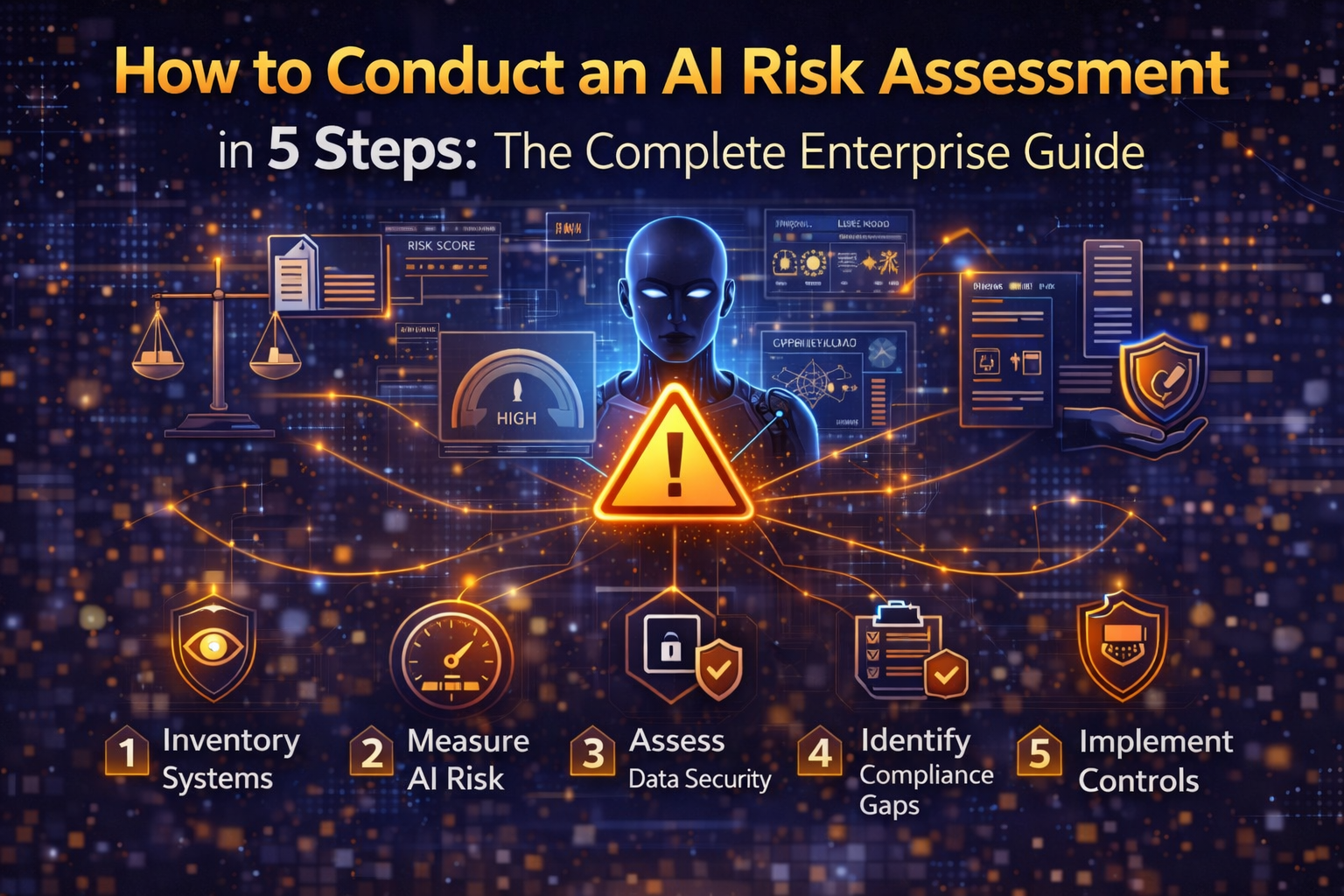
An AI risk assessment is the structured process of identifying, analyzing, and prioritizing the risks that AI systems introduce before those risks become security incidents, bias lawsuits, compliance failures, or operational breakdowns. And in 2026, conducting one is no longer optional. The regulatory, legal, and financial stakes for enterprises that skip this step have never been higher.
The data makes the urgency concrete. Gartner projects that by 2026, over 80% of enterprises will have generative AI models deployed in production environments up from less than 5% in 2023. AI-related data loss violations across enterprise AI tools reached 4.2 million in a single year, according to Zscaler’s 2025 Data Risk Report. The Workday class-action lawsuit certified in May 2025, representing hundreds of thousands of job applicants who allege systematic algorithmic discrimination demonstrated that enterprises cannot outsource AI risk to their vendors: liability for biased AI outputs sits with the deploying organization. And Italy’s €15 million fine of OpenAI for GDPR violations in AI training data processing confirmed that regulators are willing to impose significant financial consequences for insufficient AI oversight.
Yet despite these consequences, only 25% of organizations have fully operational AI risk management programs. 50% of CxOs believe their current risk approach is insufficient to address the next wave of AI technologies. And 86% of organizations with advanced AI adoption say they have discovered significant governance gaps in the process. The implementation gap is not a knowledge problem it is an execution problem. Most enterprise teams understand that AI risk assessment is necessary. Far fewer have a practical, repeatable framework for conducting one.
This guide provides that framework: a five-step AI risk assessment process grounded in the NIST AI Risk Management Framework, aligned with EU AI Act requirements, and built for the operational realities of enterprise AI in 2026. Each step includes the tools you need, the questions you must answer, and the documentation your regulators and auditors will expect to see.
Why AI Risk Assessment Is Different from Traditional IT Risk Assessment
Before walking through the five steps, it is worth being precise about why AI risk assessment requires a distinct approach not a repurposing of the risk management frameworks that most enterprise security and compliance teams already operate.
AI Systems Produce Non-Deterministic Outputs
Traditional IT risk assessment can validate a system’s behavior against a fixed specification and assume that validated behavior will continue. AI systems cannot be governed this way. The same input submitted twice to the same LLM can produce different outputs. Model behavior drifts over time as data distributions change. A system that behaves safely in pre-deployment testing may surface unexpected outputs in production when users interact with it in ways the testing did not anticipate. AI risk assessment must therefore include ongoing monitoring as a first-class activity, not a post-implementation afterthought.
The Risks Are Multidimensional and Interconnected
Traditional IT risk is primarily a security and availability problem. AI risk spans security, bias and fairness, accuracy and reliability, privacy, explainability, regulatory compliance, third-party vendor liability, and reputational damage simultaneously, and in ways that interact. An AI hiring tool with a bias problem is simultaneously a discrimination law violation risk, a reputational risk, an EEOC enforcement risk, and in EU jurisdictions, an EU AI Act compliance risk. An AI system that processes health data is simultaneously a HIPAA risk, a prompt injection risk, an accuracy and liability risk, and a Shadow AI risk if employees are using unapproved tools to supplement it. Risk assessment frameworks that evaluate these dimensions in isolation will miss the compound risks that matter most.
The Regulatory Accountability Cannot Be Outsourced
Perhaps the most important difference: when an enterprise deploys a third-party AI model or vendor-built AI tool, the enterprise not the vendor bears primary accountability for how that system affects the people it touches. The Workday lawsuit, in which a federal court greenlit claims that an AI vendor’s tools systematically discriminated against applicants, clarified that AI vendors can be held liable as agents of the deploying employer but it also confirmed that the deploying organization remains responsible for ensuring the AI it uses is compliant with applicable law. Your AI vendor’s terms of service do not transfer your regulatory obligations. Your AI risk assessment must cover third-party AI with the same rigor it applies to internally built systems.
The 2026 AI Risk Landscape: What You Are Assessing Against
Understanding the specific risk categories that AI systems introduce is the foundation of a meaningful assessment. Here is the current map of enterprise AI risk, organized by category with real-world 2025–2026 examples and applicable regulatory exposure:
| Risk Category | What It Looks Like in Practice | 2025–26 Example | Regulatory Exposure |
| Security & Adversarial | Prompt injection, model poisoning, data exfiltration, jailbreaking, API abuse | 4.2M data loss violations via enterprise AI tools in 2025 (Zscaler) | EU AI Act, GDPR, SOC 2, ISO 42001 |
| Bias & Fairness | Discriminatory outputs in hiring, lending, healthcare, insurance based on protected characteristics | Workday lawsuit certified May 2025; Clearview AI $50M biometric privacy settlement | EEOC, Title VII, ADEA, GDPR Art. 22, EU AI Act (high-risk) |
| Data Privacy & Leakage | Sensitive data entering AI via prompts; AI outputs surfacing regulated data; Shadow AI data flows | €15M fine of OpenAI by Italy (GDPR); 48% of employees uploaded sensitive data to AI tools | GDPR, CCPA, HIPAA, EU AI Act, GLBA |
| Accuracy & Reliability | Hallucinations, model drift, incorrect decisions, over-reliance on AI outputs | Air Canada chatbot fined for incorrect bereavement fare guidance (2024) | FTC consumer protection, sector-specific liability, negligence claims |
| Explainability & Transparency | Black-box decisions that cannot be explained to affected individuals or regulators | 40% of orgs flag AI explainability as main risk; only 17% actively mitigating it | GDPR Art. 13–15 (right to explanation), EU AI Act, SEC disclosure |
| Third-Party & Supply Chain | AI vendor models introducing bias, data exposure, or compliance failures the deployer inherits | Workday vendor liability ruling; 40% of 2024 breaches from third-party vendors | EU AI Act (deployer accountability), ISO 27001, SOC 2 vendor clauses |
| Agentic & Autonomous AI | AI agents taking unauthorized actions, over-privileged access, prompt injection via tool calls | Only 1 in 5 companies has mature agentic AI governance (Deloitte, 2026) | EU AI Act, emerging agentic AI guidance, NIST AI RMF |
| Regulatory Non-Compliance | Failing to document, classify, or disclose AI systems as required by applicable regulations | Global fines for AI/data non-compliance exceeded $2.6B in 2024; EU AI Act fines up to €35M | EU AI Act, GDPR, FTC, SEC, California AB 2013, HIPAA |
🚨 The Cost of Skipping AI Risk Assessment: The average cost of a data breach in 2025 was $4.88 million (IBM). Shadow AI adds a $670,000 premium per incident. EU AI Act violations carry fines up to €35 million or 7% of global turnover. And a single bias lawsuit like the Workday case can expose the deploying organization to liability spanning hundreds of thousands of affected individuals. The cost of a formal AI risk assessment is a fraction of any one of these outcomes.
How to Conduct an AI Risk Assessment in 5 Steps
The following framework is grounded in the NIST AI Risk Management Framework’s Govern-Map-Measure-Manage structure, aligned with EU AI Act conformity assessment requirements, and adapted for the operational realities of enterprise AI deployment in 2026. Each step includes specific tools, output deliverables, and the questions your governance documentation must answer.
STEP 1 Build Your AI Inventory and Define System Scope Know what you are assessing before you assess it
You cannot assess the risk of AI systems you do not know exist. The first step of every AI risk assessment is building a complete, current inventory of every AI system operating inside your organization including AI systems that were never formally approved, AI tools embedded inside third-party software your teams use daily, AI agents operating on automated schedules, and browser extensions that silently access enterprise data.
This is consistently the step that enterprises underestimate. A rigorous AI discovery exercise in a 5,000-person organization typically reveals three to five times more AI systems in active use than the security team’s pre-audit estimate. Shadow AI is not fringe behavior 65% of AI tools operating inside enterprises currently lack IT approval, and 77% of organizations are actively working on governance that they have not yet completed.
How to Build Your AI Inventory
- OAuth audit: Review all third-party application authorizations granted by your identity provider. AI tools frequently request OAuth access to productivity suites, email, calendar, and storage. This single data source often reveals dozens of AI applications that IT has no record of.
- Network and DNS analysis: Monitor DNS queries and network traffic for connections to known AI service endpoints (OpenAI, Anthropic, Cohere, Mistral, Hugging Face, Azure OpenAI, Google Vertex AI, and others). Traffic patterns reveal both approved and Shadow AI usage.
- Endpoint agent scan: Use endpoint management tooling to scan for installed software, browser extensions, and locally running AI tools. Browser extensions are particularly high-risk because they can read page content including page content that contains sensitive enterprise data.
- Department self-reporting: Conduct a structured survey of all business units asking what AI tools they use, for what purpose, and with what data. Anonymous self-reporting typically surfaces use cases that network monitoring misses, particularly for personal device usage.
- Vendor contract review: Audit existing vendor contracts for embedded AI capabilities. ERP platforms, CRM tools, productivity suites, HR systems, and customer service platforms have all added AI features in recent years many activated by default without explicit approval.
What to Document for Each AI System
For every AI system in the inventory, document the following minimum fields. This information feeds directly into Step 2 (risk classification) and forms the foundation of your AI risk register:
| Field | What to Capture |
| System name and description | What the system does and its intended use case |
| Vendor / developer | Who built or provides the system; whether it is internal, third-party SaaS, or open-source |
| Deployment status | In production, in testing, in development, or in proof-of-concept |
| Business owner | The organizational unit responsible for this system and its outcomes |
| User population | Who uses the system employees, customers, patients, job applicants, or others |
| Data types processed | What categories of data the system ingests, processes, generates, or transmits |
| Decision impact | Whether the system informs, influences, or makes decisions; the nature and reversibility of those decisions |
| Integration scope | What other systems the AI connects to via API, plugin, or data pipeline |
| Approval status | Whether the system is formally approved, unapproved (Shadow AI), or under review |
📋 Step 1 Deliverable: A complete, continuously maintained AI inventory covering every AI system in scope. This document is your primary reference for all subsequent assessment steps and the first thing regulators will ask for in a compliance audit. The inventory should be reviewed and updated at minimum quarterly, and whenever a new AI system is deployed or discovered.
STEP 2 Classify Each AI System by Risk Tier Govern proportionally not every system carries the same risk
Once your inventory is complete, each AI system must be classified by its risk level. Risk classification determines the depth and rigor of the assessment each system receives, the governance controls required, the regulatory obligations triggered, and the priority order for remediation. An AI system that schedules meeting rooms requires less governance rigor than an AI system that screens job applicants or recommends medical treatments and risk classification makes that distinction systematic and defensible.
The EU AI Act provides the most widely adopted classification framework, used increasingly as the global standard by organizations regardless of whether they are subject to EU jurisdiction. It classifies AI systems across four tiers:
| Risk Tier | Definition | Enterprise Examples | Governance Required |
| Unacceptable Risk (Prohibited) | AI practices that pose unacceptable risks to fundamental rights and are banned outright under the EU AI Act | Social scoring systems; subliminal manipulation; real-time biometric surveillance in public spaces (with narrow exceptions) | Discontinue immediately. Deployment is a regulatory violation. |
| High Risk | AI systems used in regulated domains where failure can cause significant harm to individuals | AI hiring tools, credit scoring, benefits eligibility, CV screening, biometric identification, critical infrastructure management, medical diagnostics, educational assessment | Full governance: risk assessment, conformity documentation, human oversight, technical robustness testing, registration in EU database (where applicable), ongoing monitoring. |
| Limited Risk | AI systems that interact with humans or generate content, where transparency obligations apply | Chatbots, AI-generated content tools, emotion recognition systems | Transparency requirements: users must be informed they are interacting with AI. Content labeling where required. |
| Minimal Risk | AI systems with low potential for harm to individuals or society | Spam filters, AI-powered search, recommendation engines for non-sensitive content, productivity assistants | Voluntary governance under AI usage policy. Regular access review and basic monitoring. |
How to Classify Systems with Multiple Risk Factors
Many enterprise AI systems fall across multiple risk tiers depending on their specific use case. A general-purpose LLM used for drafting marketing copy (minimal risk) is the same underlying model as one used to draft HR performance reviews that influence employment decisions (high risk). Classification must be applied to the specific deployment context the use case, the user population affected, the decisions informed or made, and the reversibility of harm not to the underlying model in the abstract.
When in doubt, classify higher. The cost of applying more governance rigor to a system that turns out to be lower-risk is operational overhead. The cost of applying insufficient governance to a high-risk system is regulatory exposure, legal liability, and potential harm to individuals. The EU AI Act’s conformity assessment structure already accounts for this organizations that self-assess and document their classification rationale have a defensible position; organizations that simply fail to classify have none.
⚠️ Classification Warning: The Workday bias lawsuit was certified despite Workday’s argument that its AI was a vendor tool, not a hiring tool per se. Courts and regulators are assessing AI risk by actual impact on individuals, not by how vendors categorize their products. Apply the same standard to your own classification: if your AI system’s outputs affect employment, credit, housing, healthcare, education, or access to essential services it is high-risk, regardless of how the vendor frames it.
📋 Step 2 Deliverable: An AI risk register that records the risk tier classification of every inventoried system, the classification rationale, the applicable regulatory frameworks, and the business owner responsible for governance. This register is the core governance document that drives the remaining assessment steps and all subsequent reporting.
STEP 3 Identify and Score Specific Risks for Each System Move from categories to measurable, prioritized risk statements
Risk tier classification tells you how much governance rigor a system requires. Specific risk identification tells you what, exactly, you are governing against. For each AI system in your inventory starting with high-risk systems you must identify the specific risks it poses, assess the likelihood and potential impact of each risk, and produce a prioritized risk score that determines where governance controls must be applied first.
The NIST AI RMF’s MAP function provides the structure for this step: identify the contexts in which the AI system will operate, the potential harms associated with each context, and the populations at risk. The Measure function adds quantification translating identified risks into scored assessments that can be prioritized and tracked over time.
The Five Risk Dimensions to Assess for Every High-Risk AI System
- Security risks: Prompt injection vulnerabilities, model manipulation, data exfiltration through AI outputs, API abuse, adversarial inputs designed to produce incorrect or harmful outputs. For agentic AI: tool invocation abuse, over-privileged access exploitation, and cross-system lateral movement via agent APIs. Score against OWASP Top 10 for LLM Applications and OWASP Top 10 for Agentic AI (December 2025 update).
- Bias and fairness risks: Statistical disparities in outcomes across protected class groups (race, gender, age, disability, national origin). For each AI system that makes or influences decisions affecting individuals, conduct disparate impact analysis: are outcomes distributed equitably across demographic groups? The EEOC’s enforcement history and the Workday lawsuit demonstrate that unintentional bias carries the same legal exposure as intentional discrimination.
- Privacy and data risks: What sensitive data flows into the system through user inputs, retrieved context, or connected data sources? What data does the system produce in outputs? Are those data flows authorized under applicable privacy frameworks (GDPR, CCPA, HIPAA)? Does the system retain user inputs or outputs in ways that create data subject rights obligations?
- Accuracy and reliability risks: How often does the system produce incorrect, hallucinated, or misleading outputs? What is the impact of an incorrect output in this specific use case is it easily corrected (low impact) or does it drive an irreversible decision (high impact)? Model drift risk: how often is the model retrained, and what is the governance process for validating retrained models before production deployment?
- Explainability and accountability risks: Can the system’s outputs be explained to affected individuals in a meaningful way? Is there a documented process for humans to review and override AI recommendations? If the system produces a harmful output, is there a clear accountability chain from the output back to the process owner, the training data, or the configuration that produced it?
Risk Scoring: Building a Consistent Methodology
Risk scoring should be consistent across all assessed systems so that relative prioritization is meaningful. A standard 5×5 likelihood-impact matrix provides a defensible, audit-ready scoring methodology:
| Likelihood → | Rare (1) | Unlikely (2) | Possible (3) | Likely (4) | Almost Certain (5) |
| Critical Impact (5) | 5 | 10 | 15 | 20 | 25 |
| Major Impact (4) | 4 | 8 | 12 | 16 | 20 |
| Moderate Impact (3) | 3 | 6 | 9 | 12 | 15 |
| Minor Impact (2) | 2 | 4 | 6 | 8 | 10 |
| Negligible Impact (1) | 1 | 2 | 3 | 4 | 5 |
| Score Range | Risk Level | Governance Response |
| 20–25 | Critical | Immediate remediation required. Do not deploy or suspend if in production until controls are in place. Escalate to CISO and General Counsel. |
| 15–19 | High | Prioritized remediation within 30 days. Enhanced monitoring, mandatory human oversight, and executive notification. |
| 10–14 | Medium | Planned remediation within 90 days. Standard governance controls applied. Included in quarterly review. |
| 5–9 | Low | Controls applied as standard practice. Reviewed annually or when the system undergoes significant change. |
| 1–4 | Minimal | Documented and monitored. No additional controls required beyond standard AI usage policy. |
📋 Step 3 Deliverable: A completed risk register entry for each assessed AI system, including risk dimension scores, overall risk rating, risk rationale, and prioritized remediation plan. Critical and High risks must have named owners, target remediation dates, and escalation records. This documentation is the evidence base for both internal governance and regulatory compliance.
STEP 4 Design and Implement Controls Proportional to Risk Targeted mitigations not checkbox compliance
Risk identification without control implementation is documentation theater. The fourth step of the AI risk assessment process is designing and deploying specific controls that reduce the likelihood or impact of each identified risk to an acceptable residual level. Controls should be proportional to the risk score produced in Step 3 Critical and High risks require layered, technically enforced controls; Minimal risks require monitoring and documented policy.
The NIST AI RMF’s MANAGE function frames this step: prioritize the risks identified in MAP and MEASURE, select mitigations appropriate to the risk level, implement those mitigations, and document residual risk after controls are in place. The EU AI Act’s technical requirements for high-risk AI systems map directly to this step the Act specifies the control categories required, but leaves the specific implementation to the deploying organization.
Control Categories by Risk Dimension
| Risk Dimension | Primary Controls | Compensating Controls |
| Security | Prompt injection defenses; input validation; output filtering; API rate limiting; adversarial testing; EDR on AI endpoints; RBAC for AI access | Regular red-team testing; incident response plan for AI-specific attacks; SIEM integration for AI interaction logs |
| Bias & Fairness | Pre-deployment bias audit (statistical disparate impact testing); diverse test data; human review for high-impact decisions; third-party bias assessment for vendor AI | Regular bias monitoring post-deployment; bias incident response process; documentation of bias testing for regulatory evidence |
| Data Privacy | Prompt inspection and PII redaction; DLP extended to AI endpoints; data minimization in AI prompts; CASB for cloud AI data flows; consent management for AI data processing | Privacy impact assessment for new AI systems; data subject request process that covers AI-generated data; records of processing activities (ROPA) updated for AI |
| Accuracy & Reliability | Output quality testing before deployment; confidence thresholds and uncertainty flagging; human-in-the-loop for high-stakes decisions; model drift monitoring; clear correction processes for incorrect outputs | User training on AI limitations; documented escalation path for disputed AI outputs; liability clauses in AI vendor contracts |
| Explainability | Logging of model version, inputs, and outputs for each significant decision; model cards and system cards maintained; user-facing explanations for AI-driven decisions; human override mechanism | Explainability review for high-risk deployments; documentation of explanation methodology for regulators; appeals process for individuals affected by AI decisions |
| Agentic AI | Unique agent identity in IdP; least-privilege tool access; behavioral monitoring with anomaly alerts; time-limited agent sessions; prompt injection protection for agent tool calls | Regular agent access reviews; agent deprovisioning automation; multi-agent interaction monitoring for compound risks |
The Human Oversight Requirement Non-Negotiable for High-Risk AI
One control deserves specific attention because it is both the most commonly neglected and the most explicitly required by the EU AI Act for high-risk AI systems: meaningful human oversight. The Act requires that high-risk AI systems be designed so that humans can understand, monitor, and override the system’s outputs. This is not satisfied by adding a ‘reviewed by human’ checkbox to an automated process where no human has the time, information, or authority to genuinely override the AI recommendation.
Genuine human oversight for high-risk AI means: the human reviewer understands what the AI system is doing and what its limitations are; the reviewer has access to the information needed to make an independent judgment; the reviewer has the authority and organizational permission to override the AI recommendation; and overrides are logged and analyzed to improve the system. In the Workday lawsuit context, enterprises that had this kind of meaningful human oversight of AI hiring decisions are significantly better positioned than those that treated AI recommendations as final hiring decisions.
📋 Step 4 Deliverable: A control implementation plan for each assessed AI system, documenting: the specific controls selected for each risk dimension, the implementation status of each control, the residual risk after controls, and the human oversight mechanisms in place for high-risk AI systems. This plan is reviewed and updated quarterly and whenever the AI system undergoes significant changes.
STEP 5 Build Continuous Monitoring and Audit-Ready Documentation Risk assessment is not a one-time event
The fifth step is where most enterprise AI risk programs fall short. Organizations treat risk assessment as a project with a completion date conduct the assessment, document the findings, file the report. AI risk management does not work this way. AI systems evolve. Data distributions change. New attack techniques emerge. Regulations are updated. And employees use AI in ways that were not anticipated when the initial assessment was conducted. Continuous monitoring is not a best practice addition to AI risk assessment. It is a core requirement.
NIST’s AI RMF makes this explicit: risk management requires ongoing measurement and tracking of identified risks, updated risk assessment when systems undergo significant change, and feedback mechanisms that capture production performance data and use it to refine risk models. The EU AI Act requires high-risk AI systems to be subject to post-market monitoring plans that continuously evaluate performance against documented requirements.
What Continuous Monitoring Covers
- Model performance and drift monitoring: Track whether the AI system’s outputs are maintaining the accuracy and fairness characteristics validated at deployment. Model drift where live data distributions diverge from training data is a routine occurrence that can gradually degrade model performance and introduce new bias patterns without triggering any obvious alert. Automated drift detection tools can flag when live input distributions diverge from training baselines.
- Security event monitoring: All AI interaction logs should flow into the SIEM for correlation with other security events. Configure real-time alerts for prompt injection attempts, unusual access patterns, access to sensitive AI systems outside business hours, and AI output anomalies that may indicate manipulation or jailbreaking.
- Bias monitoring post-deployment: Conduct quarterly analysis of AI output distributions across protected class groups for any AI system making or influencing decisions about individuals. Disparate impact patterns that were not present at deployment can emerge as data and user populations change.
- Shadow AI surveillance: Maintain continuous discovery of new AI tools entering the environment. New Shadow AI deployments represent unassessed risk a system not in the inventory is a system not under governance.
- Regulatory horizon scanning: Monitor for new or updated regulations, enforcement actions, and guidance that affect your AI systems. The EU AI Act’s August 2026 enforcement deadline for high-risk AI is the most immediate, but California AB 2013, SEC AI disclosure guidance, and sector-specific AI regulations are all evolving in parallel.
Building Audit-Ready Documentation from Day One
The documentation produced across all five assessment steps is not internal working material. It is the evidence base that regulators, auditors, investors, and litigation discovery will access when they examine your AI governance program. Build documentation with the auditor’s perspective from the start complete, current, organized, and structured to answer the specific questions that regulatory frameworks ask.
The EU AI Act’s technical documentation requirements for high-risk AI systems are the most detailed currently in force, and they serve as a useful benchmark for any enterprise building audit-ready AI risk documentation:
| Documentation Element | What It Must Contain |
| AI System Description | Purpose, capabilities, limitations, intended user population, intended deployment context, and interaction with other systems |
| Risk Classification Rationale | The documented reasoning for the assigned risk tier, referencing specific EU AI Act articles or NIST AI RMF categories where applicable |
| Risk Assessment Results | Risk register with likelihood-impact scores, risk dimension analysis, and identified risk owners for each assessed system |
| Control Implementation Evidence | Specific controls deployed, implementation dates, testing results, and residual risk after controls |
| Bias Testing Results | Statistical results of pre-deployment bias testing, methodology used, test data description, and findings for each protected class group assessed |
| Human Oversight Mechanisms | Description of oversight processes, the qualifications of human reviewers, override procedures, and override rate tracking |
| Post-Market Monitoring Plan | Continuous monitoring approach, metrics tracked, alert thresholds, review cadence, and escalation procedures |
| Incident Records | Log of AI-related incidents, near-misses, and policy violations with root cause analysis and remediation documentation |
| Third-Party AI Vendor Due Diligence | Vendor assessment records, contractual compliance warranties, audit rights provisions, and ongoing monitoring records |
| Regulatory Mapping | Explicit mapping of each AI system’s controls to the specific articles of applicable regulations (EU AI Act, GDPR, HIPAA, etc.) |
📋 Step 5 Deliverable: A continuous monitoring program with defined metrics, alert thresholds, review cadence, and escalation procedures plus a complete, current documentation package for every high-risk AI system that answers the questions regulators will ask. The documentation package should be reviewed and recertified at minimum annually, and within 30 days of any significant system change.
AI Risk Assessment Completion Checklist
Use this checklist to verify that your AI risk assessment is complete and audit-ready. Each unchecked item is an active governance gap.
Step 1: AI Inventory
- Complete AI inventory conducted including Shadow AI discovery
- All AI systems documented with minimum required fields (name, owner, data types, decision impact, approval status)
- Inventory maintenance process established with quarterly review cadence
- Third-party and vendor AI catalogued alongside internally built systems
Step 2: Risk Classification
- Every inventoried AI system assigned a risk tier with documented rationale
- High-risk AI systems identified and prioritized for full assessment
- AI risk register created and accessible to governance stakeholders
- Regulatory frameworks applicable to each system documented in the register
Step 3: Risk Identification and Scoring
- Security risks assessed using OWASP LLM Top 10 and Agentic AI Top 10
- Bias and fairness analysis conducted for AI systems affecting individuals
- Data privacy risk assessed and mapped to applicable privacy regulations
- Accuracy and reliability risks scored with impact assessment for incorrect outputs
- Explainability and accountability risks documented with human oversight plan
- Risk scores calculated using consistent likelihood-impact methodology
Step 4: Controls
- Controls selected and implemented for each high and critical risk
- Human oversight mechanisms documented and operational for all high-risk AI
- Residual risk calculated after controls and reviewed by risk owner
- Third-party vendor controls assessed and documented
- Vendor contracts include AI compliance warranties and audit rights
Step 5: Monitoring and Documentation
- Continuous monitoring program operational with defined metrics and alert thresholds
- Model drift detection in place for all production AI systems
- Post-market monitoring plan documented for all high-risk AI systems
- Full audit-ready documentation package complete for each high-risk system
- Regulatory mapping documented for all applicable frameworks
- AI incident response plan tested and current
5 AI Risk Assessment Mistakes That Undermine Enterprise Programs
- Assessing the model, not the deployment. The risk of an AI system is not intrinsic to the underlying model it is a function of how the model is deployed, by whom, in what context, affecting what populations. A general-purpose LLM is minimal risk when helping employees draft internal documents and potentially high risk when generating outputs that inform employment decisions. Assess the deployment context, not the technology in isolation.
- Conducting the assessment once and filing it. AI risk assessment is a continuous activity, not a project milestone. Models drift. Attack techniques evolve. Regulations are updated. Users find new ways to use AI systems that were not anticipated at assessment time. The organizations that face enforcement actions and litigation are disproportionately those whose governance programs have not kept up with the systems they are supposed to govern.
- Ignoring third-party and vendor AI. The Workday lawsuit is the clearest recent signal that deploying a vendor’s AI tool does not transfer accountability to the vendor. Every AI system in your risk assessment including embedded AI in HR platforms, CRM tools, and productivity suites requires the same risk assessment rigor as internally built AI. Vendor AI that makes or influences decisions about individuals is high-risk, regardless of what the vendor calls it.
- Treating bias testing as a one-time pre-deployment activity. Bias in AI systems is not a fixed characteristic it can emerge or worsen as data distributions change, as the user population evolves, and as the system’s operating context shifts. Post-deployment bias monitoring is as important as pre-deployment bias testing, particularly for any AI system operating in areas of employment, lending, healthcare, or benefits decisions.
- Producing risk documentation that cannot survive an audit. Risk documentation that describes what an organization intends to do rather than what it is currently doing, with evidence fails the audit readiness test. Regulators and auditors in 2026 expect operational evidence: current logs, current control configurations, current bias testing results, and documented human oversight decisions. Build your documentation infrastructure to produce this evidence continuously, not to be assembled in response to an audit notice.
The Bottom Line: AI Risk Assessment Is How You Keep AI Working for You, Not Against You
The enterprises that will scale AI most successfully in 2026 and beyond are not those that take the fewest governance precautions. They are the ones that have built risk assessment processes robust enough to give them genuine confidence about what their AI systems are doing, what risks they carry, and what controls are in place. That confidence is what enables faster AI deployment not slower because governance that works eliminates the uncertainty that causes boards, legal teams, and regulators to pump the brakes.
The five-step framework in this guide inventory, classification, risk scoring, controls, and continuous monitoring is not the most complex approach to AI risk management available. It is the most executable one: grounded in NIST AI RMF and EU AI Act requirements, informed by the enforcement actions and lawsuit outcomes of 2025, and structured to produce governance evidence that regulators will recognize and respect.
The cost of building this program is real but finite. The cost of the Workday liability exposure, the €15 million GDPR fine, the $4.88 million average data breach, and the reputational damage of a public AI bias incident are not. The math of AI risk assessment has always favored the organizations that do it proactively.
Need help executing your AI risk assessment program?
AccuroAI’s AI Security & Governance Platform automates the discovery, classification, and continuous monitoring steps that are most difficult to execute manually giving your risk assessment program operational infrastructure rather than just a framework to follow. From AI inventory and Shadow AI detection to runtime prompt inspection, bias monitoring, and audit-ready compliance reporting, AccuroAI makes AI risk assessment repeatable, scalable, and regulatorily defensible.
Request a demo at accuroai.co