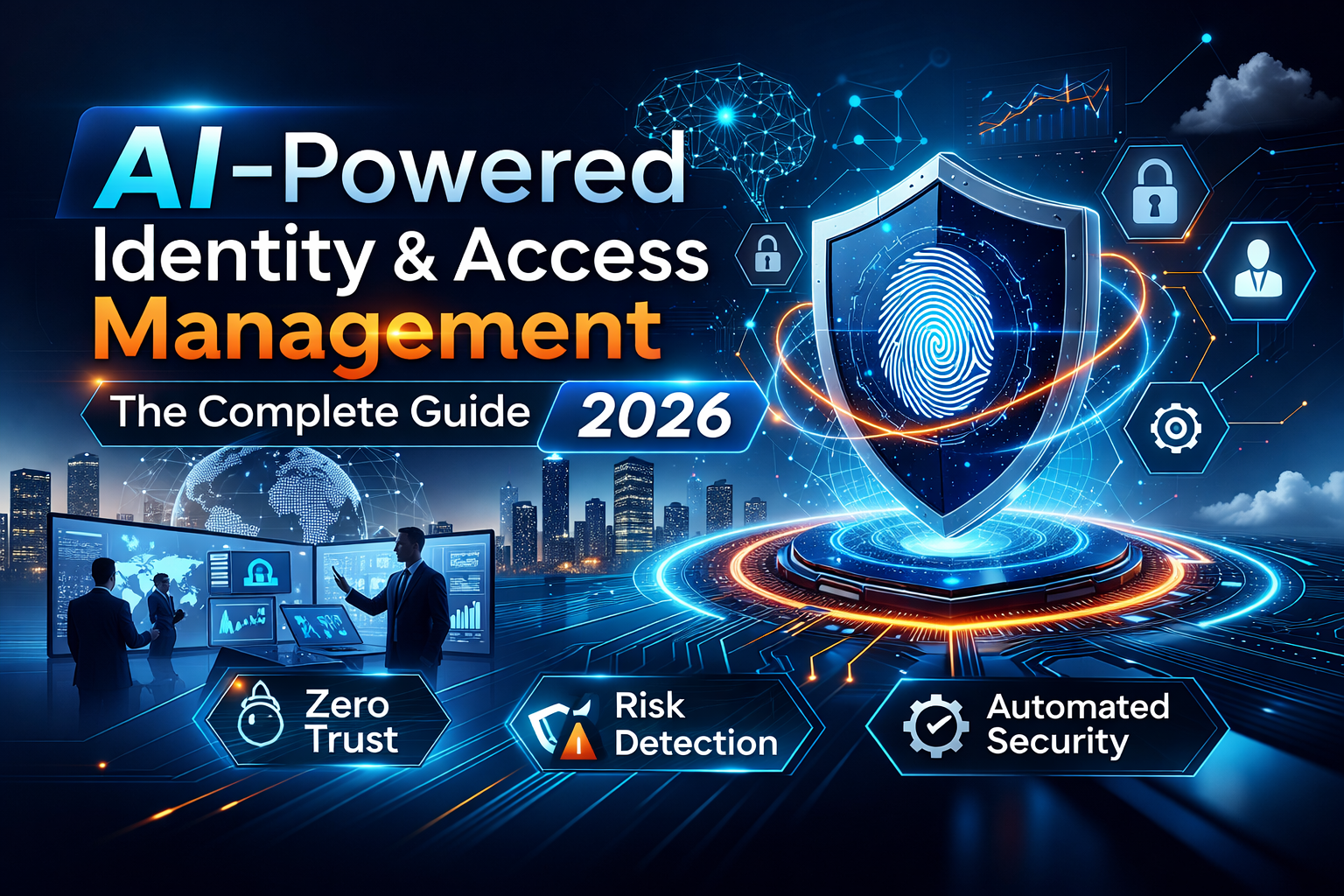
What Is AI-Powered Identity and Access Management? A Complete Guide (2026)
Artificial Intelligence is no longer a futuristic concept in cybersecurity. In 2026, it has become a necessity. One of the most transformative applications of AI in enterprise security is AI-powered Identity and Access Management (AI IAM).
As cyberattacks grow more sophisticated and insider threats become harder to detect, traditional rule-based Identity and Access Management systems are no longer sufficient. Enterprises now require adaptive, intelligent, and predictive access controls.
This guide explains what AI-powered Identity and Access Management is, how it works, why enterprises need it, and how leading organizations are using it to secure their digital ecosystems.
What Is Identity and Access Management (IAM)?
Before understanding AI IAM, we must define traditional IAM.
Identity and Access Management (IAM) is a cybersecurity framework that ensures the right individuals have the right access to the right resources at the right time.
It includes:
- User authentication (passwords, MFA)
- Authorization policies (role-based access control)
- User lifecycle management
- Privileged access management
- Single Sign-On (SSO)
- Identity governance and compliance
Traditional IAM systems operate using static rules and predefined policies. For example:
“If user is in Finance, grant access to finance software.”
This works until it doesn’t.
Modern cyber threats exploit:
- Stolen credentials
- Session hijacking
- Insider privilege abuse
- Lateral movement within networks
- AI-generated phishing
Static IAM cannot detect subtle behavioral anomalies.
That is where AI-powered IAM changes the game.
What Is AI-Powered Identity and Access Management?
AI-powered Identity and Access Management (AI IAM) uses artificial intelligence and machine learning to analyze user behavior, assess risk dynamically, and automate access decisions in real time.
Instead of asking:
“Does this user belong to this role?”
AI IAM asks:
“Is this access request consistent with this user’s behavior, device, location, and historical patterns?”
It moves IAM from rule-based to risk-based, context-aware, and predictive security.
Core Components of AI IAM
AI-powered Identity and Access Management systems integrate intelligence into multiple layers:
1. Behavioral Analytics
AI builds a baseline of normal user behavior:
- Login times
- Devices used
- Location patterns
- Application usage
- Access frequency
If deviations occur, the system flags risk.
Example:
A CFO usually logs in from Mumbai during business hours.
Suddenly, login occurs from Eastern Europe at 2:30 AM.
AI flags high risk and triggers step-up authentication.
2. Risk-Based Authentication (RBA)
Traditional MFA applies uniformly.
AI IAM applies adaptive MFA based on risk score.
Low Risk:
- Trusted device
- Known location
- Normal behavior
→ Seamless login
High Risk:
- New device
- Unusual time
- Suspicious IP
→ Biometric + OTP + security challenge
This reduces friction while improving security.
3. Continuous Authentication
Instead of verifying identity only at login, AI IAM continuously evaluates session behavior.
If abnormal behavior appears mid-session:
- Access can be revoked
- Session can be terminated
- Additional verification can be triggered
4. Privileged Access Monitoring
AI detects abnormal admin behavior:
- Unusual database queries
- Mass downloads
- Configuration changes
- Access outside normal maintenance windows
This protects against insider threats and compromised admin credentials.
5. Automated Identity Governance
AI can:
- Detect excessive permissions
- Recommend least-privilege adjustments
- Auto-revoke dormant accounts
- Identify toxic access combinations
This significantly reduces audit and compliance burden.
How AI IAM Works: Step-by-Step
- Data Collection
Logs from authentication systems, endpoints, cloud apps, VPN, and SIEM tools are aggregated. - Baseline Modeling
Machine learning models create behavioral fingerprints per user. - Risk Scoring
Every access request receives a real-time risk score. - Decision Engine
Policies + AI risk score determine outcome:- Allow
- Step-up authentication
- Block
- Alert SOC
- Continuous Learning
Models adapt as user behavior evolves.
Why Traditional IAM Is No Longer Enough in 2026
1. Explosion of Cloud & SaaS
Enterprises use 200+ SaaS applications on average.
2. Remote & Hybrid Workforce
Access happens from:
- Home networks
- Public WiFi
- BYOD devices
3. AI-Powered Attacks
Attackers now use AI to:
- Generate deepfake voice authentication
- Bypass CAPTCHA
- Launch large-scale phishing campaigns
Static IAM cannot keep pace.
Real-World Enterprise Examples
Example 1: Financial Services Firm
A global investment firm implemented AI IAM after multiple phishing incidents.
Outcome:
- 42% reduction in account takeover attempts
- 30% reduction in MFA fatigue complaints
- Automated de-provisioning reduced audit findings by 60%
AI detected unusual trading platform access from previously unseen devices and blocked lateral movement attempts.
Example 2: Healthcare Enterprise
A hospital network faced insider threats due to excessive privileges.
AI IAM identified:
- Nurses accessing records outside assigned departments
- Dormant accounts with admin privileges
After implementation:
- 55% reduction in privileged access risk exposure
- Compliance audit preparation time reduced by 40%
Example 3: Manufacturing Company
A manufacturing firm with distributed plants implemented AI IAM to protect OT systems.
AI flagged:
- Abnormal PLC system access from engineering accounts
- Unusual data transfers to USB devices
This prevented potential operational sabotage.
Key Benefits of AI-Powered Identity and Access Management
1. Reduced Breach Risk
Credential-based attacks account for over 60% of breaches. AI IAM dramatically reduces success rates.
2. Improved User Experience
Adaptive authentication reduces unnecessary MFA prompts.
3. Stronger Zero Trust Implementation
AI IAM aligns perfectly with Zero Trust architecture:
- Never trust
- Always verify
- Continuously assess
4. Compliance Readiness
Automated governance simplifies:
- ISO 27001
- SOC 2
- HIPAA
- GDPR
5. Operational Efficiency
Reduces manual access reviews and policy adjustments.
AI IAM vs Traditional IAM: Comparison
| Feature | Traditional IAM | AI IAM |
| Decision Model | Rule-based | Risk-based |
| Authentication | Static MFA | Adaptive MFA |
| Monitoring | Login-only | Continuous |
| Insider Threat Detection | Limited | Behavioral |
| Governance | Manual | Automated |
How AI IAM Supports Zero Trust Security
Zero Trust requires continuous validation of identity.
AI IAM enables:
- Device posture evaluation
- Real-time anomaly detection
- Context-aware policy enforcement
- Automated privilege adjustments
Without AI, Zero Trust becomes operationally overwhelming.
Challenges of Implementing AI IAM
1. Data Quality
AI depends on clean, structured identity data.
2. Integration Complexity
Requires integration with:
- Active Directory
- Cloud IdPs
- Endpoint tools
- SIEM
3. Change Management
Security teams must adapt to AI-driven decision models.
4. Explainability
Enterprises require transparent AI decisions for compliance.
Leading platforms now include explainable AI dashboards.
AI IAM and Regulatory Compliance in 2026
Regulators increasingly expect:
- Continuous access monitoring
- Just-in-time access
- Privileged access tracking
- Behavioral anomaly detection
AI IAM aligns with modern regulatory expectations.
AI IAM Market Trends (2026)
- Growing adoption among mid-market enterprises
- AI-driven passwordless authentication
- Integration with biometric verification
- AI-powered identity threat detection and response (ITDR)
- Expansion into OT and IoT environments
Enterprises are moving toward unified identity security platforms powered by AI.
How to Choose an AI IAM Solution
When evaluating vendors, consider:
- Behavioral Modeling Capabilities
- Risk Scoring Transparency
- Integration Ecosystem
- Privileged Access Analytics
- Compliance Automation
- Scalability for Multi-Cloud
- Support for Hybrid Infrastructure
A robust AI IAM solution should combine intelligence, automation, and governance.
The Future of AI-Powered Identity Security
By 2028, AI IAM will likely include:
- AI-generated identity risk forecasts
- Autonomous privilege adjustments
- Deepfake-resistant authentication
- Identity digital twins for risk simulation
Identity will become the new security perimeter.
And AI will guard it.
Final Thoughts
AI-powered Identity and Access Management is no longer optional for enterprises.
In 2026, identity is the primary attack surface. Traditional IAM systems are reactive. AI IAM is proactive.
It detects anomalies before breaches occur.
It adapts authentication dynamically.
It automates governance intelligently.
It strengthens Zero Trust frameworks.
For B2B enterprises seeking to reduce breach risk, improve compliance posture, and enable secure digital transformation, AI IAM is a foundational pillar.
If your organization is evaluating next-generation identity security architecture, AI-powered IAM should be at the center of your cybersecurity roadmap.