
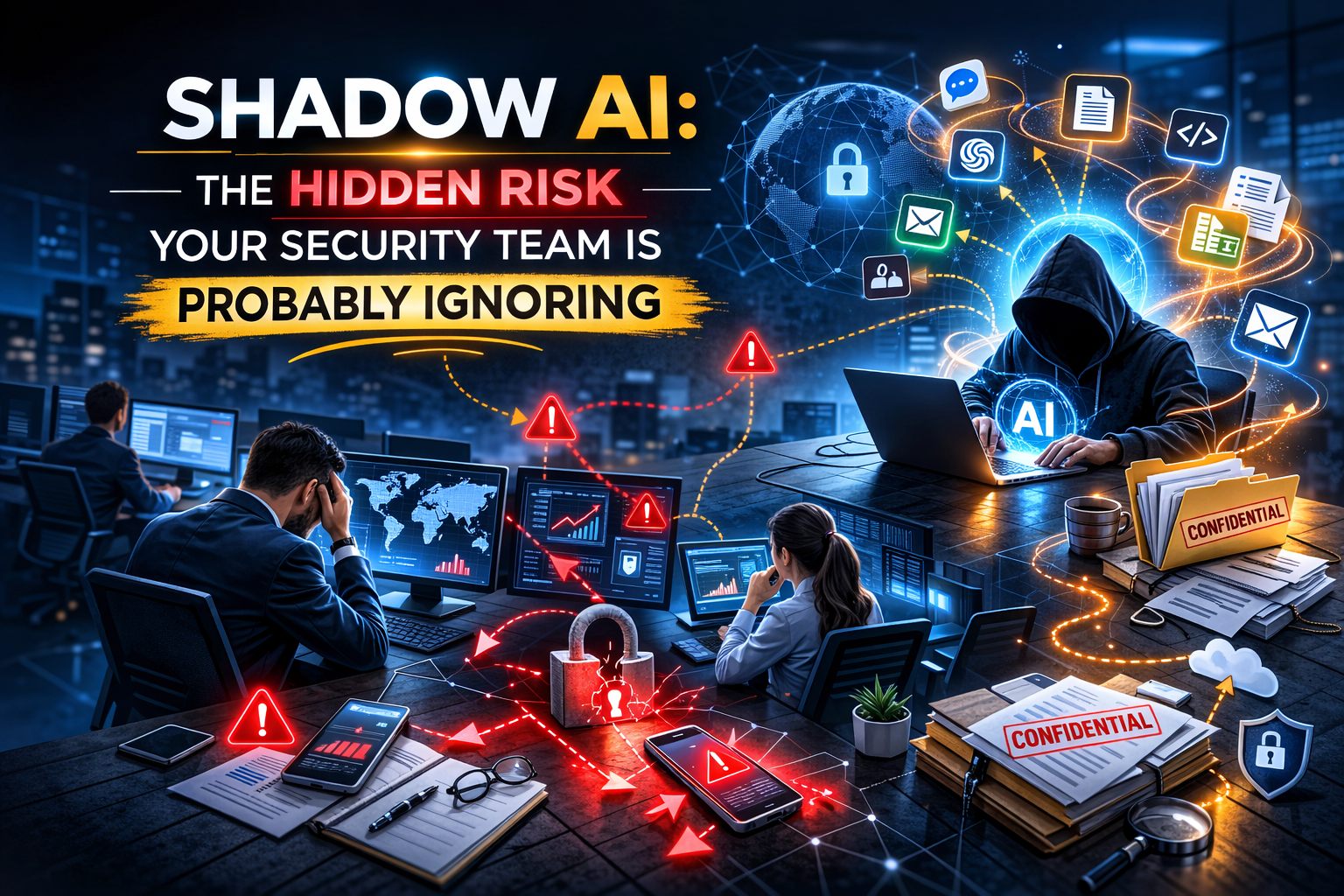
Picture this: A product manager at your company signs up for an AI writing assistant to help draft customer emails. A data analyst starts using a free AI tool to summarize sales reports. A developer plugs your internal codebase into a cloud-based AI code reviewer. None of them filed a ticket. None of them asked IT. And none of them had any idea they might be exposing sensitive company data to third-party AI models with unknown data retention policies.
This is Shadow AI and it’s already inside your organization.
Shadow AI is one of the fastest-growing and least-understood risks in enterprise security today. Unlike traditional shadow IT, which typically involves unapproved SaaS apps or personal devices, Shadow AI introduces a new layer of danger: your employees aren’t just using unauthorized tools, they’re feeding those tools your most sensitive data, often without realizing the consequences.
What Exactly Is Shadow AI?
Shadow AI refers to the use of artificial intelligence tools, applications, or models by employees or teams without the knowledge, approval, or oversight of the IT or security department. It’s the AI equivalent of shadow IT but with much higher stakes.
Shadow AI can take many forms:
- Consumer AI chatbots (like ChatGPT, Gemini, or Claude) used for work tasks outside of approved enterprise plans
- AI browser extensions that summarize, rewrite, or translate content on screen
- Free AI coding assistants connected to internal repositories
- AI-powered document tools that process uploaded files in the cloud
- Departmental AI initiatives launched without security review
The common thread: your security team has no visibility, no control, and no way to assess the risk.
Why Shadow AI Is Spreading So Fast
To understand why Shadow AI is exploding, you need to understand the employee’s perspective. AI tools genuinely make people more productive. They help write faster, analyze better, and solve problems that used to take hours. When an employee discovers a tool that makes their job easier, the natural impulse is to use it not to wait weeks for an IT approval process.
Several forces are accelerating this trend:
- Availability: Hundreds of capable AI tools are available for free or at low cost, requiring nothing more than an email address to sign up.
- Accessibility: AI tools are increasingly embedded in everyday software browsers, email clients, productivity suites making adoption nearly frictionless.
- Competitive pressure: Employees feel pressure to deliver results. If AI helps them get there faster, they’ll use it regardless of policy.
- Policy gaps: Many organizations lack clear AI usage policies, leaving employees to make their own judgments about what’s acceptable.
The Real Risks: What’s Actually at Stake
Shadow AI isn’t just a policy violation, it’s a multi-dimensional security risk. Here’s what your organization is actually exposed to:
1. Data Leakage
When employees paste customer PII, financial projections, internal code, proprietary strategies, or legal documents into an unapproved AI tool, that data may be transmitted to external servers, used to train future models, stored indefinitely, or processed by third-party vendors with unclear security practices. A single well-intentioned employee summarizing a confidential deal memo with a consumer AI tool could result in a serious data breach without a single firewall being breached.
2. Compliance and Regulatory Violations
Organizations operating under GDPR, HIPAA, SOC 2, PCI-DSS, or sector-specific regulations have strict obligations around how data is processed and where it goes. Using an unapproved AI tool to process regulated data even briefly can trigger compliance violations that carry significant legal and financial consequences. The EU AI Act is introducing further requirements around transparency and risk management for AI systems, making governance of AI tool usage a regulatory imperative, not just a best practice.
3. Intellectual Property Exposure
Source code, product roadmaps, unreleased research, and competitive strategies are among the most sensitive assets an organization holds. When developers use unapproved AI coding assistants or employees upload product documents to AI summarization tools, that IP may become part of a model’s training data potentially surfacing in outputs generated for other users.
4. Supply Chain and Third-Party Risk
Every unapproved AI tool is an unvetted third party in your supply chain. You don’t know who built it, how it handles your data, what security controls are in place, or whether it’s been audited. This dramatically expands your attack surface in ways that are nearly impossible to monitor without dedicated tooling.
5. AI-Specific Attack Vectors
Shadow AI also introduces risks unique to AI systems. Prompt injection where malicious instructions embedded in content manipulate an AI’s behavior can have serious consequences when employees use AI to process untrusted inputs like emails, documents, or web content. Without security controls around how AI is used, these vectors go undetected.
Why Traditional Security Controls Aren’t Enough
Many security teams assume their existing controls DLP, web filtering, endpoint protection will catch Shadow AI risks. They won’t. Here’s why:
- Encrypted traffic: Most AI tools communicate over HTTPS, making it difficult to inspect data being transmitted without advanced SSL inspection.
- Browser-based access: Employees access AI tools through browsers, which often bypass traditional network controls.
- Rapid proliferation: New AI tools appear constantly. Maintaining a blocklist is a losing battle against a category growing this fast.
- Context blindness: Traditional DLP can flag keywords but can’t understand the contextual risk of data being processed by an AI model.
How to Address Shadow AI: A Practical Framework
Addressing Shadow AI requires a combination of visibility, policy, governance, and the right technology. Here’s a practical framework to get started:
Step 1: Discover What’s Already In Use
You can’t manage what you can’t see. Start by auditing your environment for AI tool usage. Review network logs, browser history policies, OAuth app authorizations, and expense reports for AI-related subscriptions. Deploy tooling that provides ongoing visibility into AI application usage across your organization.
Step 2: Establish a Clear AI Usage Policy
Many employees use Shadow AI not out of malice but because they don’t know the rules. Create and communicate a clear AI usage policy that defines which tools are approved, what data can and cannot be processed by external AI systems, how employees can request approval for new AI tools, and the consequences of policy violations.
Step 3: Create an Approved AI Catalog
Prohibition alone doesn’t work. Employees will continue finding workarounds if their needs aren’t being met. Build and maintain a catalog of approved, security-vetted AI tools that employees can use. Make the approval process visible and reasonably fast if it takes three months to approve a tool, employees will skip it.
Step 4: Implement AI-Specific Governance Controls
Beyond policy, you need technical controls designed specifically for AI risks. This includes monitoring for sensitive data being sent to AI endpoints, enforcing data classification restrictions on AI tool usage, conducting regular AI risk assessments for approved tools, and establishing an AI governance committee with cross-functional representation.
Step 5: Train Employees Not Just Security Teams
Shadow AI is fundamentally a human problem, not just a technical one. Invest in security awareness training that specifically addresses AI risks. Help employees understand why certain data should never be processed by external AI, what the approved alternatives are, and how to identify and report potentially risky AI tools.
The Bottom Line
Shadow AI is not a future risk, it’s a present one. The question isn’t whether your employees are using unapproved AI tools. The question is whether you know about it, and whether you have the controls in place to manage the risk.
The organizations that will navigate this challenge successfully aren’t those that try to ban AI entirely, they’re those that meet employees where they are, understand the real threat landscape, and build governance frameworks that enable safe, productive AI use at scale.
Your security team is probably already behind on Shadow AI. The good news: it’s not too late to catch up.
Want to see what Shadow AI looks like inside your organization?
AccuroAI’s AI Security & Governance Platform gives your security team complete visibility into AI tool usage across your enterprise so you can identify risks, enforce policy, and enable safe AI adoption without slowing your business down.