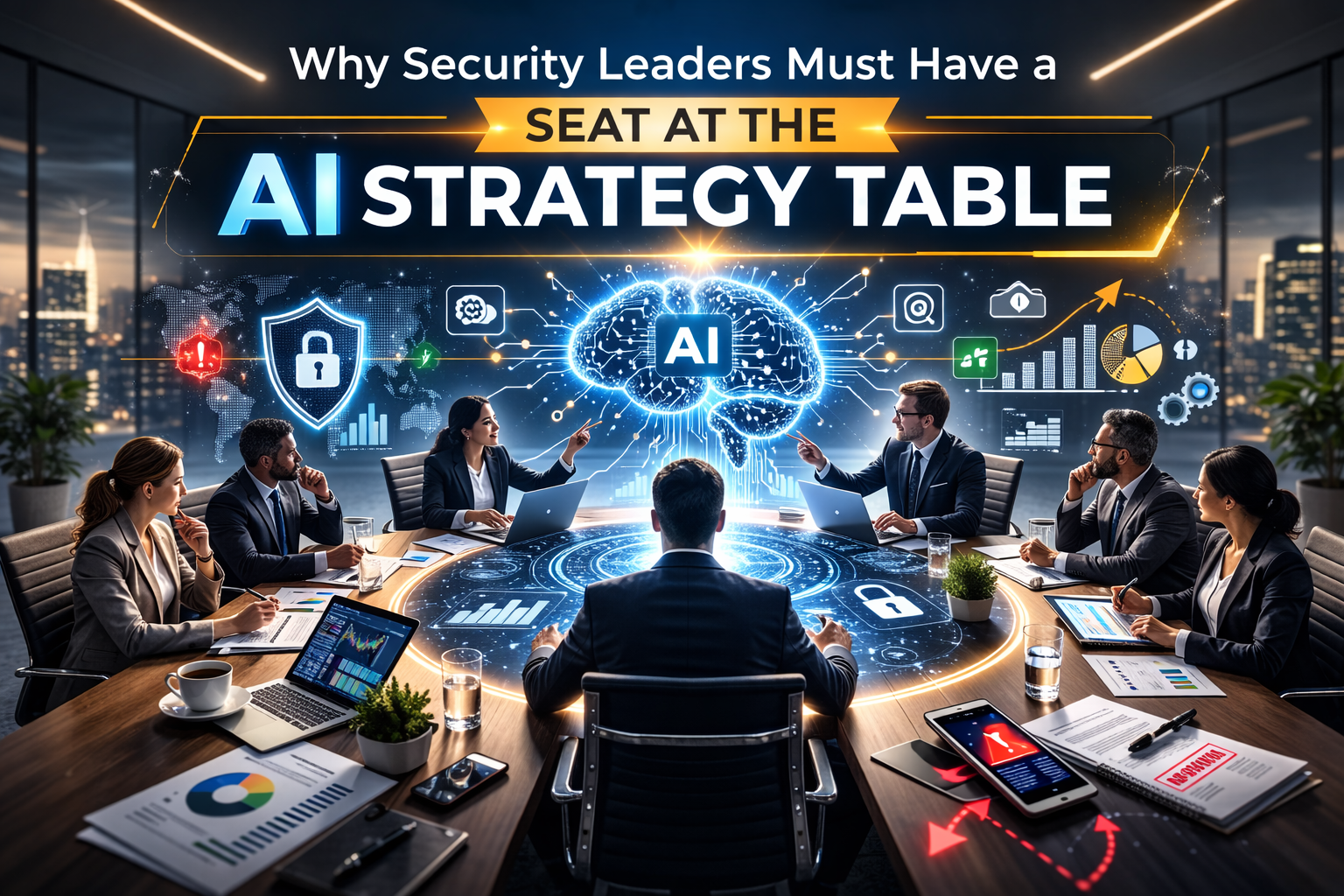
There’s a meeting happening right now at companies around the world. The CEO is excited about a new AI initiative. The CTO has a vendor shortlist. The CFO is reviewing the budget. The head of product is mapping use cases. And the CISO? They found out about it in an email thread three weeks after the pilot was already running.
This scenario plays out with uncomfortable regularity in enterprises of every size and sector. AI is being treated as a product decision, a technology decision, even a finance decision but rarely as a security decision. And that gap is creating risks that are costly, complex, and in many cases, completely avoidable.
The CISO’s role has always been to protect the organization from risk. But AI doesn’t just introduce new risks to existing systems, it fundamentally changes the nature of risk itself. That’s why security leaders don’t just deserve a seat at the AI strategy table. They’re essential to it.
The Gap Between AI Ambition and AI Security
Enterprise AI adoption is accelerating at a pace that is outrunning governance. According to industry research, the majority of large enterprises are now running AI in production across multiple business functions. Yet a significant portion of those same organizations report that security teams are not consistently involved in AI deployment decisions.
The result is a widening gap between AI ambition and AI security. Business units move fast because they’re incentivized to deliver results. Security teams move carefully because they’re accountable for what goes wrong. When the two operate in silos, neither serves the organization well.
The consequences of this gap are real and growing. Data breaches caused by insecure AI deployments. Compliance violations triggered by AI tools processing regulated data without proper controls. Reputational damage from AI systems producing harmful, biased, or legally problematic outputs. And an expanding attack surface that adversaries are actively probing for weaknesses.
Why AI Is Different From Every Other Technology Decision
Security leaders have always needed to be involved in major technology decisions. So what makes AI different? Why is this moment particularly critical for CISOs to assert their role in strategic conversations?
AI Makes Decisions And Those Decisions Carry Risk
Traditional software does what it’s told. AI systems make inferences, generate outputs, and in agentic configurations, take actions often with limited human oversight. When an AI system makes a decision that causes harm denying a loan application incorrectly, generating misleading content, or taking an unauthorized action in an automated pipeline the organization is responsible. The CISO needs to understand and be able to articulate the risk profile of every AI system in production.
AI Expands the Attack Surface in Novel Ways
AI systems introduce attack vectors that have no equivalent in traditional software security. Prompt injection allows malicious actors to manipulate AI behavior through crafted inputs. Model poisoning can corrupt an AI system’s outputs at the training level. Data extraction attacks can cause AI models to regurgitate sensitive information from their training data. These threats require security expertise to understand, assess, and defend against and they can’t be managed by teams who aren’t involved until after deployment.
AI Changes the Risk Profile of Your Data
When you deploy an AI system that processes your organization’s data, you’re not just using that data, you’re potentially embedding it, transforming it, and making it accessible in new ways. An AI model trained on internal documents might surface sensitive information in response to seemingly innocuous queries. An AI tool with broad data access can become an extremely high-value target for attackers. The CISO’s understanding of data classification, access controls, and data governance is directly relevant to how AI systems should be designed and deployed.
AI Compliance Is Becoming Mandatory
The regulatory landscape around AI is evolving rapidly. The EU AI Act, NIST AI Risk Management Framework, ISO 42001, and a growing number of sector-specific regulations are establishing formal requirements for AI governance, transparency, and risk management. Organizations that deploy AI without compliance expertise in the loop face significant legal and financial exposure. The CISO who already understands the compliance landscape is uniquely positioned to navigate these requirements.
What CISOs Bring to the AI Strategy Table
Some business leaders view security involvement in AI strategy as a constraint, a force that slows things down and says no to good ideas. This framing gets it exactly backwards. Here’s what CISOs actually bring to AI strategy conversations:
Risk Quantification and Prioritization
CISOs are trained to quantify and prioritize risk. In AI strategy discussions, this is invaluable. Not every AI initiative carries the same risk profile. A CISO can help the organization distinguish between low-risk, high-value AI applications that should be fast-tracked and higher-risk deployments that require additional scrutiny and controls. This isn’t about blocking AI it’s about deploying it intelligently.
Vendor and Supply Chain Assessment
Every AI vendor is a potential entry point for risk. CISOs understand how to evaluate third-party vendors: their security posture, data handling practices, contractual obligations, and incident response capabilities. In a market flooded with AI vendors making bold claims, security-led vendor assessment is a critical filter before any enterprise commitment.
Policy and Governance Architecture
Building an AI governance framework requires exactly the skills that CISOs have spent their careers developing: policy writing, control design, audit and monitoring, incident response planning, and cross-functional stakeholder management. The CISO shouldn’t just be consulted on AI governance they should be one of its primary architects.
Incident Response Readiness
When an AI system fails and at some point, one will need the organization to respond quickly and effectively. CISOs lead incident response programs. Ensuring that AI incidents are covered in those programs, that runbooks exist, and that teams know how to respond to AI-specific failures is a direct extension of the CISO’s existing mandate.
The Cost of Keeping CISOs Out of the Conversation
Organizations that exclude security leadership from AI strategy don’t avoid the costs of security; they just pay them later, and at a much higher price. Consider what happens when security is an afterthought in AI deployment:
- Retrofitting security controls: Rebuilding security architecture after deployment is exponentially more expensive than designing it from the start.
- Regulatory penalties: Non-compliant AI deployments can result in fines, forced remediation, and public disclosure requirements that carry significant financial and reputational costs.
- Breach costs: AI systems with weak security controls can become high-value targets. A breach involving AI-processed data can be far more damaging than a traditional breach due to the volume and sensitivity of data involved.
- Trust erosion: Customers, partners, and regulators are paying close attention to how enterprises manage AI risk. A high-profile AI failure can do lasting damage to an organization’s reputation and relationships.
How CISOs Can Claim Their Seat at the Table
Recognizing that CISOs should be involved in AI strategy is one thing. Making it happen in practice requires deliberate action both from security leaders themselves and from the organizations they serve.
Build AI Fluency
CISOs who want to lead AI strategy conversations need to understand AI deeply enough to engage credibly with technical teams, vendors, and the board. This means investing in education around how large language models work, what agentic AI systems are capable of, how AI supply chains are structured, and what the threat landscape looks like. You don’t need to be a data scientist but you need to speak the language.
Lead with Business Enablement, Not Risk Avoidance
The most effective CISOs in AI strategy conversations position themselves as enablers, not blockers. Instead of leading with what can’t be done, lead with how to do it safely. When a business unit wants to deploy an AI tool, your first response shouldn’t be a list of concerns it should be a process that gets them to a secure deployment as efficiently as possible. This reframes security as a competitive advantage rather than an obstacle.
Establish an AI Security Charter
Work with executive leadership to formalize the CISO’s role in AI governance. This could take the form of an AI Security Charter that defines the security team’s responsibilities in AI decisions, establishes mandatory review gates for AI deployments above a certain risk threshold, and creates clear escalation paths when AI initiatives raise security concerns. Having this in writing removes ambiguity and ensures security involvement is structural, not optional.
Partner With the AI Center of Excellence
Many enterprises are establishing AI Centers of Excellence to coordinate AI strategy and deployment. CISOs should actively seek representation in these bodies not as an external reviewer, but as a core member. This positions security as a design-time consideration rather than a deployment-time checkpoint, which is both more effective and more efficient.
Make AI Risk Visible to the Board
Board-level conversations about AI tend to focus on opportunity. CISOs can add enormous value by ensuring that risk is equally visible. Develop an AI risk reporting framework that gives the board a clear, accurate picture of the organization’s AI risk posture, what tools are in use, what the key risk areas are, what controls are in place, and what residual risks remain. When boards understand AI risk in business terms, they’re more likely to support the investment in security that AI governance requires.
What the Best Organizations Are Already Doing
The organizations navigating AI adoption most successfully share a common characteristic: they treat security as a strategic function, not a compliance function. In these organizations, the CISO is part of the AI strategy conversation from day one. Security requirements are built into AI procurement criteria, not bolted on after contract signature. Risk assessments are conducted before pilots, not after problems emerge.
These organizations also recognize something important: the CISO’s involvement doesn’t slow down AI adoption. It accelerates sustainable AI adoption, the kind that doesn’t generate costly incidents, regulatory scrutiny, or forced remediation projects six months down the road.
The Bottom Line
AI is the most consequential technology transformation most enterprises will undergo in this decade. The organizations that get it right will be those that treat it as a strategic priority across every dimension including security. CISOs who step into the AI strategy conversation bring a perspective that no other executive can: a rigorous, systematic understanding of risk, governance, and what it takes to operate powerful systems responsibly at scale.
The seat is there. Security leaders need to take it and organizations need to make sure it’s offered.
Is your security team part of your organization’s AI strategy?
AccuroAI gives CISOs and security teams the visibility, governance tools, and risk frameworks they need to lead AI strategy with confidence and enable their organizations to deploy AI securely at scale.
Request a demo at accuroai.co