
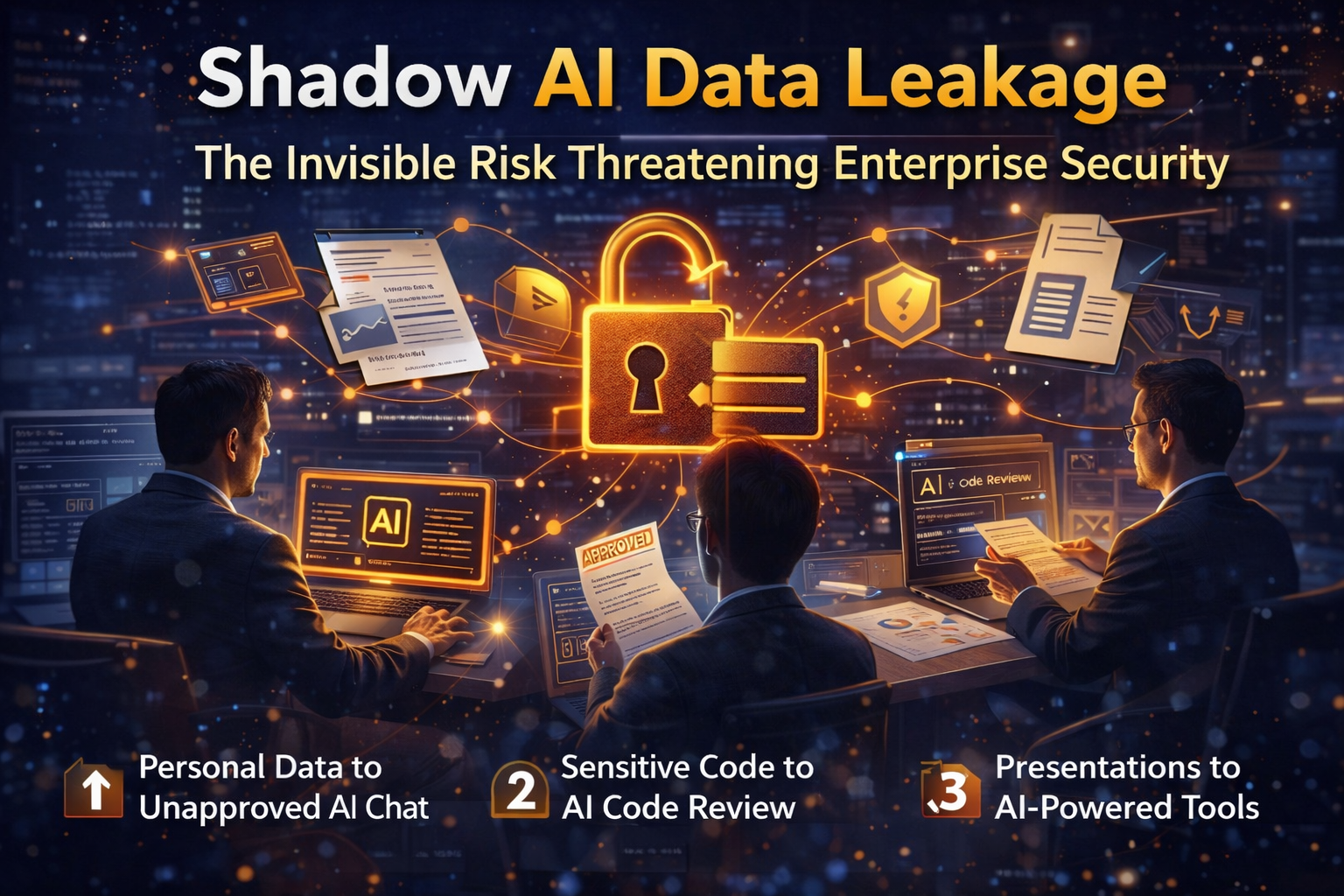
The Scale of Shadow AI: What the 2026 Data Actually Shows
The headline statistics are alarming enough. But when you dig into the research published in late 2025 and early 2026, the picture is significantly worse than most enterprise security teams have internalized.| Finding | Statistic | Source |
| Employees using AI tools weekly for work | 86% | BlackFog, Jan 2026 |
| Employees who use unapproved AI tools at work | 80%+ | UpGuard, Nov 2025 |
| Security professionals using unapproved AI | ~90% | UpGuard, Nov 2025 |
| Employees who uploaded sensitive data to AI | 48% | Fast Company survey, Jan 2026 |
| Employees who violated AI policy at work | 44% | Fast Company survey, Jan 2026 |
| Employees sharing sensitive data without employer permission | 38%+ | CybSafe/NCA, 2025 |
| Employees who hid AI use from their employer | 59% | Cybernews, Oct 2025 |
| Organizations blind to AI data flows | 86% | 2025 State of Shadow AI Report |
| Average unauthorized apps per enterprise | 1,200+ | 2025 State of Shadow AI Report |
| Employees connecting AI tools to work systems without IT approval | 51% | BlackFog, Jan 2026 |
| Organizations with actual data leaks from employee AI use | 68% | Metomic survey, 2025 |
| Organizations with comprehensive AI governance in place | Less than 1 in 3 | ISACA, 2025 |
| Employees who received any training on safe AI use | 48% (i.e., 52% had not) | CybSafe/NCA, 2025 |
What Data Are Employees Actually Leaking? The Breakdown
Understanding which types of sensitive data are flowing into unauthorized AI tools is essential for prioritizing your defenses. The BlackFog research gives us the most granular picture available:33% of employees have shared research data or internal data sets with unapproved AI tools. (BlackFog, Jan 2026)
27% have shared employee data including staff names, payroll records, or performance information. (BlackFog, Jan 2026)
23% have shared financial statements or sales data with unauthorized AI systems. (BlackFog, Jan 2026)
The Knostic AI analysis adds additional texture: 8.5% of analyzed AI prompts contained potentially sensitive data, including customer information, legal documents, and proprietary source code. Cisco’s 2025 study found that 46% of organizations had already experienced internal data leaks through generative AI. And a 2024 analysis found that 27% of organizations reported more than 30% of their AI-processed data contained private information, including customer records, financial data, and trade secrets. What makes this data exposure uniquely dangerous compared to traditional shadow IT is the nature of how AI processes information. When an employee stored files in an unauthorized Dropbox account, the files were the risk. When an employee pastes those same files into an AI chat, the risk is compounded: the AI ingests, analyzes, and potentially retains the content; the prompt itself reveals context, intent, and strategic sensitivity that raw data does not; and in consumer AI products, that data may be used for model training, surfacing in responses to entirely unrelated users. The Prompt Intelligence Problem: When an employee asks an AI to ‘summarize this contract and flag terms unfavorable to us,’ they expose not just the contract contents they expose your negotiating strategy, your risk tolerance, and your legal priorities. The prompt itself is corporate intelligence. Traditional DLP tools are not built to detect this.
Why Employees Do It Anyway: The Behavioral Reality
Before an organization can solve the Shadow AI problem, it needs to understand why employees behave the way they do. The data makes clear that this is not a malice problem it is a misalignment problem. Employees are not trying to harm their organizations. They are trying to get their work done, and AI tools make that dramatically easier.They Think It Is Fine Because Nobody Told Them Otherwise
The CybSafe and National Cybersecurity Alliance survey found that 52% of employees had received no training on safe AI use. In a 2025 survey of over 12,000 white-collar workers, 60.2% reported using AI tools at work, but only 18.5% were aware of any official company policy on AI use. When employees do not know the rules, they do not follow them not out of defiance, but because there are no rules to follow. The policy vacuum is the first and most fundamental driver of Shadow AI.They Believe the Risk Is Acceptable Even When It Is Not
BlackFog’s research found that 63% of employees believe it is acceptable to use AI tools without IT oversight when no approved option is available. This reflects a rational if incorrect judgment: if the company is not providing tools that meet their needs, employees feel entitled to find their own. The implication is important: banning AI without providing approved alternatives does not eliminate Shadow AI. It drives it underground, making it invisible and therefore more dangerous.They Trust AI More Than They Should
UpGuard’s November 2025 report revealed that roughly one quarter of workers consider AI tools to be their most trusted source of information above search engines, colleagues, and official company resources. This level of trust drives not just willingness to use AI, but willingness to provide AI with the context it ‘needs’ to give useful answers. Employees who trust AI implicitly are also employees who are more likely to share the sensitive context that makes AI responses relevant and actionable.The Access Gap: Executives Get Tools, Frontline Workers Do Not
The Cybernews research highlights a troubling structural inequality: executives, managers, and supervisors are significantly more likely to be equipped with employer-approved AI tools, while frontline employees are left to find their own solutions. This means Shadow AI is disproportionately concentrated among the workers with the least awareness, the least training, and the least understanding of data classification precisely the employees most likely to inadvertently expose sensitive information.The Real Cost of Shadow AI Data Leakage
Shadow AI incidents are not hypothetical future risks. They are happening today, and the financial and legal consequences are measurable.The Financial Cost
IBM’s 2025 Cost of Data Breach Report provides the clearest financial picture: breaches involving Shadow AI now cost $4.63 million on average, compared to $3.96 million for standard breaches, a premium of approximately $670,000 per incident. That is the additional cost specifically attributable to the uncontrolled AI vector. Shadow AI incidents now account for 20% of all data breaches. Gartner’s forecast projects that 40% of all data breaches will be tied to Shadow AI by 2027 if current trends continue.The Regulatory Cost
GDPR, HIPAA, CCPA, PCI-DSS, and the EU AI Act all impose obligations that are directly relevant to how AI processes personal and sensitive data. When an employee pastes customer PII into an unapproved AI tool, that data may be processed outside the EU, retained by a third party without a data processing agreement, used for model training without consent, or stored in a jurisdiction the organization has no contractual visibility into. Each of these scenarios is a potential regulatory violation. The ICO’s 2025 fine of £2.31 million against 23andMe for inadequate data governance serves as a reminder that regulators are actively pursuing AI-related data mishandling.The Operational Cost
Beyond financial penalties, Shadow AI creates operational risks that are harder to quantify but equally real. Trade secrets and competitive intelligence exposed to AI training pipelines cannot be unexposed. Proprietary source code submitted to AI code assistants may surface in suggestions to competitors. Internal strategy documents processed by consumer AI tools create discoverable evidence in litigation. And when AI-powered decisions based on Shadow AI outputs are later found to be incorrect or biased with no audit trail the reputational and legal exposure is compounded by the inability to explain or defend what happened. Real-World Impact: Samsung, Verizon, and J.P. Morgan Chase are among the major enterprises that banned ChatGPT and similar tools outright after sensitive data incidents. Samsung’s ban followed reports that engineers had uploaded proprietary source code to ChatGPT. However, security experts consistently note that bans without alternatives simply drive Shadow AI to personal devices where enterprise controls cannot reach.
Why Traditional Security Controls Are Failing Against Shadow AI
Most enterprise security architectures were built to protect against data exfiltration by external attackers. Shadow AI inverts the threat model: the exfiltration is being performed voluntarily, by authorized users, over legitimate network connections, using consumer-grade tools that generate no anomalous traffic signatures whatsoever. Traditional controls were not designed for this scenario.- DLP tools miss context: Traditional Data Loss Prevention systems flag known sensitive data patterns SSNs, credit card numbers, specific document structures. They cannot detect when an employee pastes their Q4 board presentation into an AI chat, because that presentation contains no pattern-matchable sensitive identifiers, only contextually sensitive strategic content.
- Encrypted traffic evades inspection: All major AI tools communicate over HTTPS. Without SSL/TLS inspection which many organizations avoid due to performance overhead, privacy concerns, and user backlash the content of AI tool interactions is invisible to network monitoring systems.
- Personal devices are outside the perimeter: As Christian Hanchett of Stack Cybersecurity noted in the January 2026 ClickOnDetroit report: ‘As long as it’s on a company device, you can control a user’s interactions with AI. But personal devices are where it becomes tougher.’ With 47% of employees using personal accounts for AI tools, a substantial proportion of Shadow AI activity is completely beyond the reach of endpoint controls.
- Browser extensions are invisible to most monitoring: AI browser extensions which can quietly read page content, capture form inputs, and intercept clipboard data represent a particularly dangerous and under-monitored Shadow AI vector. These tools are easy to install, rarely reviewed, and capable of continuous passive data collection.
- Blocklists cannot keep pace: Menlo Security documented over 6,500 GenAI domains and 3,000 GenAI apps in active use. No blocklist-based control can maintain coverage of a surface that grows at this rate. New tools emerge, gain popularity, and accumulate sensitive enterprise data long before they appear on any organizational blocklist.
The 6-Step Shadow AI Governance Framework: From Exposure to Control
Solving Shadow AI requires a governance framework, not a single control. Based on the evidence from organizations that have successfully reduced Shadow AI exposure, the following six-step approach addresses the problem comprehensively combining visibility, policy, enablement, and culture change.Step 1: Discover What You Cannot See Before You Try to Control It
The foundation of Shadow AI governance is visibility. You cannot govern what you cannot see, and the data is clear: 86% of organizations are currently blind to AI data flows. Begin with a multi-channel discovery effort. Review OAuth application authorizations in your identity provider AI tools frequently request integration permissions that leave a detectable trail. Audit DNS logs and network traffic for connections to known AI service domains. Conduct an anonymous employee survey to understand which AI tools people are actually using and why. Check expense reports and corporate card transactions for AI subscription spending. The results will almost certainly reveal a Shadow AI footprint significantly larger than your security team assumes. This is the baseline from which all subsequent governance decisions should be made.Step 2: Build and Publish an Approved AI Tool Catalog
Cybernews found that 85% of employees who have approved AI tools still used unapproved ones but 69% of those without approved tools had not used outside AI at all. The implication is clear: approved alternatives dramatically reduce Shadow AI. Build a curated catalog of security-vetted, enterprise-grade AI tools that cover the most common use cases your employees have identified: writing and editing, code assistance, data analysis, research, meeting summarization, and document processing. Publish this catalog somewhere employees can easily find it, and make the process for requesting additions to the catalog simple and fast. If employees trust that their needs will be met through sanctioned channels, they are far less likely to seek alternatives.Step 3: Create a Specific, Actionable AI Usage Policy
Vague policies do not change behavior. A policy that says ‘use AI responsibly’ or ‘do not share sensitive data’ provides employees with no actionable guidance because it does not define what ‘sensitive’ means in their specific context. Your AI usage policy should specify exactly which data classifications can never be entered into any AI tool even approved ones including customer PII, personally identifiable employee information, non-public financial data, unreleased product information, and legal documents. It should define which tools are approved for which data types, explain what happens to data submitted to AI tools and why certain data carries special risk, and establish a clear process for employees to report uncertainty about whether a specific use is compliant. As Christian Hanchett noted: ‘Having a list of what is allowed does more good than just saying you can’t use anything.’Step 4: Deploy AI-Specific Technical Controls Not Just Repurposed Legacy Tools
Standard DLP and web filtering tools are insufficient for Shadow AI. Organizations need controls specifically designed for AI traffic and behavior. These include AI-aware CASB (Cloud Access Security Broker) tools that provide visibility into AI tool usage across managed devices, next-generation DLP capabilities that understand contextual sensitivity rather than just pattern matching, browser extension management policies that restrict unauthorized AI extensions, and AI traffic monitoring that can detect anomalous data volumes flowing to GenAI endpoints. For organizations with significant BYOD exposure, Mobile Device Management policies that separate personal and corporate data including controlling AI tool access to corporate data on personal devices are essential.Step 5: Run AI-Specific Security Training Not General Awareness Campaigns
52% of employees have received no training on safe AI use. The CybSafe and NCA research found that training specifically tailored to AI risks is significantly more effective than general security awareness training in changing AI-related behavior. Your training program needs to explain specifically how AI tools handle submitted data including data retention policies and training data practices, why certain types of data create disproportionate risk when submitted to AI, what the approved alternatives are and how to access them, how to identify and report suspicious AI tools or extensions, and the real consequences for the organization and potentially for the employee of AI policy violations. Organizations adopting GenAI-powered, hyper-personalized security training are projected to see 40% fewer employee-caused incidents by 2026. The training format matters as much as the content: role-specific, scenario-based training consistently outperforms general e-learning modules.Step 6: Monitor Continuously and Iterate Shadow AI Is Not a One-Time Problem
Menlo Security documented over 6,500 GenAI domains in active use. New AI tools emerge weekly. The Shadow AI landscape will continue to evolve faster than any static governance framework can track. Continuous monitoring is the only sustainable solution. Establish monthly reviews of AI tool discovery data to identify new Shadow AI vectors. Build incident reporting mechanisms so employees can surface AI-related concerns without fear of punishment. Track governance metrics policy acknowledgment rates, training completion, approved tool adoption and use them to identify departments or roles where governance is weakest. Review and update your approved tool catalog and AI usage policy at least quarterly. And when Shadow AI incidents occur, treat them primarily as governance failures rather than employee failures and use them to improve the framework rather than assign blame.Shadow AI Readiness Checklist: Where Does Your Organization Stand?
Use this checklist to rapidly assess your current Shadow AI posture. Each ‘No’ represents an active exposure that should be prioritized for remediation. Visibility & Discovery- We have conducted an audit of AI tool usage across all departments in the past 90 days
- We have visibility into AI data flows across managed devices and networks
- We have reviewed OAuth integrations and identified AI applications with access to company data
- We have a published AI usage policy that specifies which data types cannot be used with AI tools
- We maintain an approved AI tool catalog that employees can access and contribute to
- Our AI policy has been communicated to all employees and acknowledgment has been documented
- We have DLP rules that cover AI tool endpoints and contextual sensitive data transmission
- We have a browser extension management policy that prevents unauthorized AI extensions
- We have CASB or equivalent tooling that provides visibility into AI tool usage on managed devices
- All employees have received AI-specific security awareness training in the past 12 months
- Employees know exactly which data types they should never submit to any AI tool
- We have a clear, non-punitive process for employees to report AI-related concerns